Who supports what
For PR
Labour Party
Andy Burnham. Came round to it publicly in 2021, called for a review after the 2024 election, told Compass in June 2025 that “PR’s time has come”, told the Observer on 31 May 2026 “I am committed to proportional representation”, announced the Commission at conference.
The Labour Party membership and conference, which has voted for PR twice, in 2021 and 2022. More than two thirds of members support it.
John McDonnell, Caroline Lucas, Clive Lewis, Alex Sobel among Labour and former Labour figures. Sobel told the i Paper that a majority of Labour MPs support an independent commission.
Almost every affiliated trade union, including Unite and Unison.
Those who would because it’s the best way to get representation closer to their vote share:
The Liberal Democrats, consistently, for a century.
Historically: Roy Jenkins, who chaired the 1998 commission that recommended AV+, and Paddy Ashdown, who negotiated it with Blair.
The Greens, the SNP and Plaid Cymru.
Lobby groups
The Electoral Reform Society, Make Votes Matter, Compass, Unlock Democracy.
Against PR
Labour Party
David Blunkett, now leading the Labour resistance, warning about small parties with outlandish views.
Keir Starmer, who called FPTP “the right system” in 2024 and said PR was “not a priority”.
Much of the Labour parliamentary party, historically on constituency-link grounds, though the 2024 intake tilts the other way.
Tony Blair, presumably, who having commissioned Roy Jenkins, received AV+ as the recommendation, and shelved it, having won a 179-seat majority on 43% of the vote.
Conservative Party
Consistently since the 1930s. No Conservative leader in the 2010s or 2020s has supported it.
David Cameron, who led the successful No campaign in the 2011 AV referendum.
Reform UK, which had backed PR but has recently abandoned it, presumably having worked out that it is now large enough to benefit from FPTP. Maybe it’s current retraction will draw them back towards PR. Let’s see..
Academic evidence
The academic evidence is not on the side of majoritarianism. Arend Lijphart’s Patterns of Democracy is the standard comparative work. It found that consensus democracies perform at least as well as majoritarian ones on economic management and inflation, and better on representation, participation and welfare outcomes.
Whilst this can’t be ignored, it isn’t a test against all the criteria I’ve set out above.
The evidence from elsewhere
Honestly, the evidence from elsewhere is a really mixed bag and doesn’t point to an obvious winner.
New Zealand.
A Royal Commission in 1986, prompted by two elections in the 1980s where the party with fewer votes won more seats, and by Muldoon’s unilateral abolition of the superannuation scheme in 1975, which became the standard example of unchecked executive power under FPTP.
They held an indicative referendum in 1992, a binding one alongside the 1993 election which carried 54% to 46%, first MMP election in 1996. 120 MPs, 71 from single-member electorates, 49 from closed party lists.
The first MMP election was inconclusive and it took two months to form a National and New Zealand First coalition. A confirmatory referendum was held in 2011: 58% voted to keep MMP, up from the 54% who voted to adopt it. Support was highest in Māori electorates at 82.8%. Among those choosing an alternative, FPTP was the most popular at 47%, so the opposition hadn’t converted to something else, it had simply shrunk.
Fifteen years in, with full knowledge of how it worked, New Zealanders endorsed it by a larger margin than they had adopted it. Only once since 1996 has a single party won an outright majority. But New Zealand has had stable governments and no constitutional crisis since the change.
Japan.
In 1994, from the single non-transferable vote in multi-member districts to a parallel system: most seats in single-member districts, the rest by regional party list.
The stated objectives were to break the Liberal Democratic Party’s one-party dominance and produce a two-party system with alternation, to cut the cost of campaigns, and to shift campaigning from individuals to parties.
Alternation happened once, in 2009, and lasted three years. The LDP returned and has dominated since. Money politics was reduced but not eliminated. The reform is generally assessed as having failed against its principal objective.
Italy.
From list PR to a mixed system in 1993. To a list system with a majority bonus in 2005. The Constitutional Court struck that down in 2013. A replacement in 2015, partly struck down in 2017. Another in 2017, still in force.
That’s four systems in twenty-five years, two of them found unconstitutional, and no improvement in governmental stability, which was the point of the exercise each time. Italy had roughly as many governments after the reforms as before.
Treating the electoral system as an instrument of party advantage, and changing it whenever the advantage shifts, corrodes the thing it is meant to improve.
Israel.
From 1996, direct election of the Prime Minister alongside PR elections for the Knesset. An attempt to graft decisive executive choice onto a proportional legislature.
It was abandoned after three elections. Voters used their Knesset vote for small parties, having already chosen the Prime Minister separately, so the legislature fragmented further and the Prime Minister’s position weakened rather than strengthened. Repealed in 2001.
France.
Mitterrand switched to proportional representation for the 1986 legislative elections and the system reverted to the two-round majoritarian one in 1988.
It was a tactical manoeuvre rather than a reform, intended to limit Socialist losses and let the Front National into the Assembly to split the right. It worked electorally and was reversed immediately.
Canada.
Four provincial referendums since 2005 and one federal promise, all failed. British Columbia in 2005 got 57.7% for STV and it failed because the threshold was 60%. Ontario in 2007, BC again in 2009 and 2018, Prince Edward Island twice. Trudeau campaigned in 2015 on 2015 being the last election under FPTP, and abandoned it in 2017.
Reform fails when it is put to a public that is broadly content, and that governments elected under FPTP lose interest once they have won under it.
I conclude from these other countries only that there is no clear steer that can be obtained from what other countries have/have done. It’s a mixed bag.
My solution
My solution has 3 components:
Decisiveness is a virtue if decisions are sound. And although you can’t guarantee sound decisions, you can construct a system that makes them more likely than not.
First off, the people can protest, and make their voice heard. The most notable case is the Poll Tax. Thatcher’s decisive Government with a big majority delivered us the Poll Tax. It was unopposed in Parliament but had to be abandoned after extensive public riots. Not a very elegant corrective measure, but an effective one. Minority Oppositions can shift decisions too, even without the votes to defeat them. Labour relabelled the under-occupancy penalty the “bedroom tax” in 2012 and campaigned on it until the courts forced exemptions for disabled children and for women in refuges. In 2021 the Government whipped its own majority to overturn a standards ruling on Owen Paterson, and reversed within twenty-four hours under public and opposition pressure. At her conference this month, Kemi Badenoch claimed three Labour u-turns in a single week, on jury trials, the family farm tax and the under-16 social media ban. None of those required a Commons majority. They required an argument that landed.
Second, my solution’s second and third components address this issue by ensuring that long-term plans are set and can’t be counteracted, and big decisions have a sound basis.
Third, General Elections come along every 5 years or less. And MPs can be recalled. Under the Recall of MPs Act 2015, any one of three things opens a recall petition in an MP’s constituency: a custodial sentence, suspension from the Commons for at least ten sitting days, or a conviction for making a false expenses claim. The petition stays open for six weeks, and if 10% of registered electors sign it the seat is vacated and a by-election follows. It has worked: Fiona Onasanya and Chris Davies in 2019, Margaret Ferrier and Peter Bone in 2023. Ian Paisley Jr survived one in 2018 when the petition fell just short. That does allow for wrong decisions but ensures there is a backstop corrective mechanism.
AV+
The Jenkins Commission was set up by Tony Blair in December 1997 and reported in September 1998. It was given four things to balance: broad proportionality, wider voter choice, stable government, and the maintenance of the constituency link. The system it designed, AV+, has never been used anywhere in the world.
You get two votes on polling day.
The first elects your own MP, in a single-member constituency much like today’s, but by the Alternative Vote rather than first past the post. You rank the candidates: 1, 2, 3. If nobody has more than half the first preferences, the last-placed candidate drops out and their second preferences are redistributed. This repeats until someone passes 50%. Your MP is one named person, responsible for your area, who has the support of a majority of voters there rather than the largest minority.
Between 80 and 85% of the Commons is elected this way.
The second elects a top-up member for your county or city. The country is divided into 80 top-up areas, based on counties and metropolitan areas. Scotland has eight, Wales five, Northern Ireland two. Each area elects one top-up member, with the largest areas electing two. This is an open list, so you vote for a named individual from a party’s list rather than simply for the party, and the candidates with most votes take the seats.
The remaining 15 to 20% of the Commons is elected this way.
The top-up seats are allocated correctively. This is the part that does the work. In each area, the count compares how many constituency seats a party has already won against its share of the second vote. The top-up seat goes to the party most under-represented by that comparison.
So, in a county with six constituencies and one top-up seat: suppose the second votes split 38% to one party, 34% to another, 20% to a third and 8% to a fourth, and the first party wins four constituencies to the second party’s two. The third party has a fifth of the votes and no MPs. The top-up seat goes to it. The county ends up with four, two and one rather than four, two and nothing.
What it does and doesn’t do. It is corrective rather than proportional. With only one or two top-up members per area, it removes the worst distortions without producing a parliament that mirrors the national vote. That was deliberate. Jenkins wanted to reduce disproportionality while keeping single-party government the normal outcome, and simulations suggest it would still have delivered Conservative majorities in 1979, 1983 and 1987, and Labour majorities in 1997 and 2001.
One thing Jenkins was clear about. The Commission rejected the Alternative Vote on its own, because AV, in its words, so far from doing much to relieve disproportionality, is capable of substantially adding to it. The 2011 referendum therefore asked the country about the one option Jenkins had explicitly ruled out, and the country rejected it by 68% to 32%.
Long-term commitments framework
Keeping first past the post means keeping the pendulum. That is the trade: decisive government, clear accountability, and a swing every decade or so that can reverse what came before.
For most of politics that is right. Tax, welfare, the size of the state, how public services are run: these are arguments about values, and values should swing with the public mood. If people want a smaller state they should be able to get one, and change their minds later.
But a small category of decisions behaves differently. Where the lead time is longer than a Parliament and the asset lasts for fifty years, reversal doesn’t just change direction, it destroys the value of everything already spent. A half-built nuclear plant or runway or train line or fighter jet is worth nothing.
The test is not important. It is whether the cost of reversing exceeds the benefit of choosing again. Three conditions, all of which must apply:
The lead time from decision to delivery exceeds one Parliament
The asset or capability has a working life beyond twenty-five years
Partial delivery is worth substantially less than none, so stopping halfway wastes what was spent
That test includes grid decarbonisation, nuclear, flood defence, strategic rail, semiconductors and critical minerals, submarines, jets and carriers, and the skills pipelines attached to them. It excludes almost everything else: health, care and the ageing population, even though they share some characteristics. Those are arguments about who pays and who receives, which is to say arguments about values, and values belong in the election. Taking them out of democratic contention would be wrong.
What already works, and what doesn’t
The Climate Change Act 2008 is the British success and the template. It passed the Commons by 463 to 3. Parliament set a statutory long-term target. An independent Climate Change Committee advises on five-year carbon budgets, set twelve years in advance, so each government inherits budgets agreed by its predecessors and sets budgets its successors will inherit. Ministers must report to Parliament and explain any shortfall.
It survived four Prime Ministers and two changes of governing party. The design features that made it work are copyable: a statutory target, an independent advisory body, rolling budget periods set beyond the current Parliament, and a duty to explain rather than a power to compel.
The Pensions Commission is the other one. Turner reported in 2005 with explicit cross-party engagement built into the process, and auto-enrolment was legislated by Labour, implemented by the Coalition and maintained by every government since. Twenty years of continuity on a question that had defeated everyone before.
The Low Pay Commission has set the minimum wage by tripartite agreement since 1999, and its recommendations have been accepted by governments of both parties almost without exception.
The failures teach as much. The Davies Commission reported on airport capacity in 2015 and was ignored. The National Infrastructure Commission has produced good analysis with no purchase on decisions. HS2 was legislated, begun, and then cut in half by a Prime Minister at a party conference. The difference between the successes and the failures is not the quality of the analysis. It is whether the framework had statutory force and whether departure had to be explained in public.
And the Climate Change Act is now under attack, with the Conservatives committed to repealing the net zero legislation.
The framework
A Long Commitments Act, creating a defined class of National Commitments, in three domains: energy and infrastructure, industrial and supply chain capability, and defence procurement and alliances.
1. Parliament sets the destination, not the route
A National Commitment is created by a vote of the House of Commons and must carry two thirds of those voting. It states an outcome and a date. Not a technology, not a supplier, not a route map.
The supermajority is the lock. Something that cannot command two thirds of the Commons is not a national commitment, it is a government policy, and it should take its chances with the electorate like everything else.
2. An independent commission sets the pathway
For each commitment, a standing commission on the Climate Change Committee model: statutory, independently appointed, with a duty to publish. It sets rolling delivery periods extending at least ten years beyond the current Parliament, and reports annually on whether the government is on track.
It advises. It does not decide and it does not spend. The decisions stay with ministers, which is what keeps this democratic rather than technocratic.
3. Government delivers, and explains
Ministers may depart from the pathway at any time. They must do so in a statement to Parliament, setting out the cost of the departure, the sunk cost written off, and the revised date. Comply or explain, not comply or else.
That is the mechanism doing the real work. It does not prevent a government from changing course, which would be undemocratic and in our constitution impossible anyway. It makes changing course expensive in the currency politicians actually care about, which is having to stand at the despatch box and account for it.
4. The money is ring-fenced and multi-year
Following the Dutch Delta Fund model, each commitment carries a funding line set for the full delivery period rather than the spending review cycle, with the National Audit Office auditing against it annually. The single greatest cause of cost inflation in British infrastructure is stop-start funding, and it is the one thing the Treasury currently guarantees.
5. Reversal takes what creation took
A National Commitment can be revoked, but only by the same two thirds majority that made it. A government with a working majority can change almost anything. It should not be able to write off twenty years of national investment on a single afternoon’s simple majority vote.
6. Every commitment is reviewed, and can expire
Each commitment is reviewed every ten years by the commission, which must publish an assessment of whether it remains the right objective. A commitment that no longer makes sense should be allowed to die. Maybe that’s where we’re getting to with Net Zero in very different economic circumstances to when the commitment was made.
What it looks like in practice
Energy. Parliament commits to a firm, dispatchable low-carbon capacity figure by a given year. The commission sets the build pathway and reports annually. A government that wants more gas and less nuclear may have it, and must explain the cost and the delay. What it cannot do is cancel a half-built programme without a two thirds vote.
Industrial capability. Parliament commits to domestic capacity in a named strategic input, semiconductors or critical minerals. The commission sets the pathway including the skills pipeline, because a fabrication plant without trained people is an empty building. Funding runs the full period, not to the next spending review.
Defence. Parliament commits to a capability, continuous at-sea deterrence, carrier availability, a drone and counter-drone capability, with the commission reporting on procurement against it. This is the domain where the convention already half-exists and where allies’ trust depends on consistency. Making it statutory tells NATO something that a manifesto cannot.
Why this is consistent with keeping FPTP
The objection to FPTP is that it produces sharp reversals on narrow mandates. The objection to PR is that it produces indecision and governments nobody voted for.
This framework takes the specific harm of the first and fixes it without accepting the second. It leaves the pendulum swinging over everything that should swing, and it fences off the small category where pendulum swings destroy value. A government still governs decisively from day one. It simply cannot write off a generation’s investment without persuading two thirds of the House that it is right to do so.
Big decisions framework
To put the UK in a more stable position for future generation-defining choices, we must replace ad-hoc, politically manipulated referendum bills with a permanent, codified framework. The power for such decisions will sit with the public, the elected House of Commons, and the devolved nations.
Issues are funnelled down two separate tracks.
Track 1: Structural and Sovereignty Issues
For changes to borders, treaties, voting systems, or international blocs, including re-entry into the EU.
55% supermajority of votes cast. A decisive mandate, but short of the overly conservative 60% bar that would make any change near-impossible.
4-Nation double majority. The proposal must win overall and achieve a simple majority in at least 2 of the 4 UK nations.
As things stand, England can carry a UK-wide vote entirely on its own, against the settled view of the other three. Under this rule it cannot. England must persuade at least one other nation to come with it, which is a real constraint and a material improvement on what we have now.
I have deliberately not set the bar at three of four. That would hand a blocking vote to whichever two nations happened to disagree, and it would stop changes that command the overwhelming support of the people actually affected by them. The point is to stop England imposing, not to make the Union ungovernable.
A 40% approval floor. The winning side must command the support of at least 40% of the whole registered electorate. This ensures a result reflects active public engagement rather than apathy. Unlike the 1979 rule, it applies to whichever side wins, so there is nothing to be gained by urging your supporters to stay at home.
And it applies symmetrically. This is the part people will argue with, so let me be plain about it. These rules would have stopped Brexit in 2016 on 51.9%. They would equally stop re-entry on 54%. I am not proposing a device to get the answer I happen to want. I am proposing that we stop making irreversible decisions on reversible margins.
Track 2: Matters of Deep Conscience and Fundamental Human Rights
For complex ethical, social or bodily autonomy choices, such as assisted dying or abortion.
Mandatory Citizens’ Assembly. Before any legislation is drafted, a randomly selected, demographically reflective panel of 100 UK citizens is convened to hear medical, legal and ethical evidence. They publish a recommended compromise framework.
Parliamentary free vote. The House of Commons debates the framework, and MPs are granted a free vote, freed from party whipping, to vote according to their conscience or in the way their constituents demand of them.
Simple majority to pass. Because the law has been heavily insulated by deliberative consensus and detailed committee work, a simple majority in the Commons is sufficient, avoiding a tyranny of the minority blocking medical or social progress.
How the whole solution answers the question
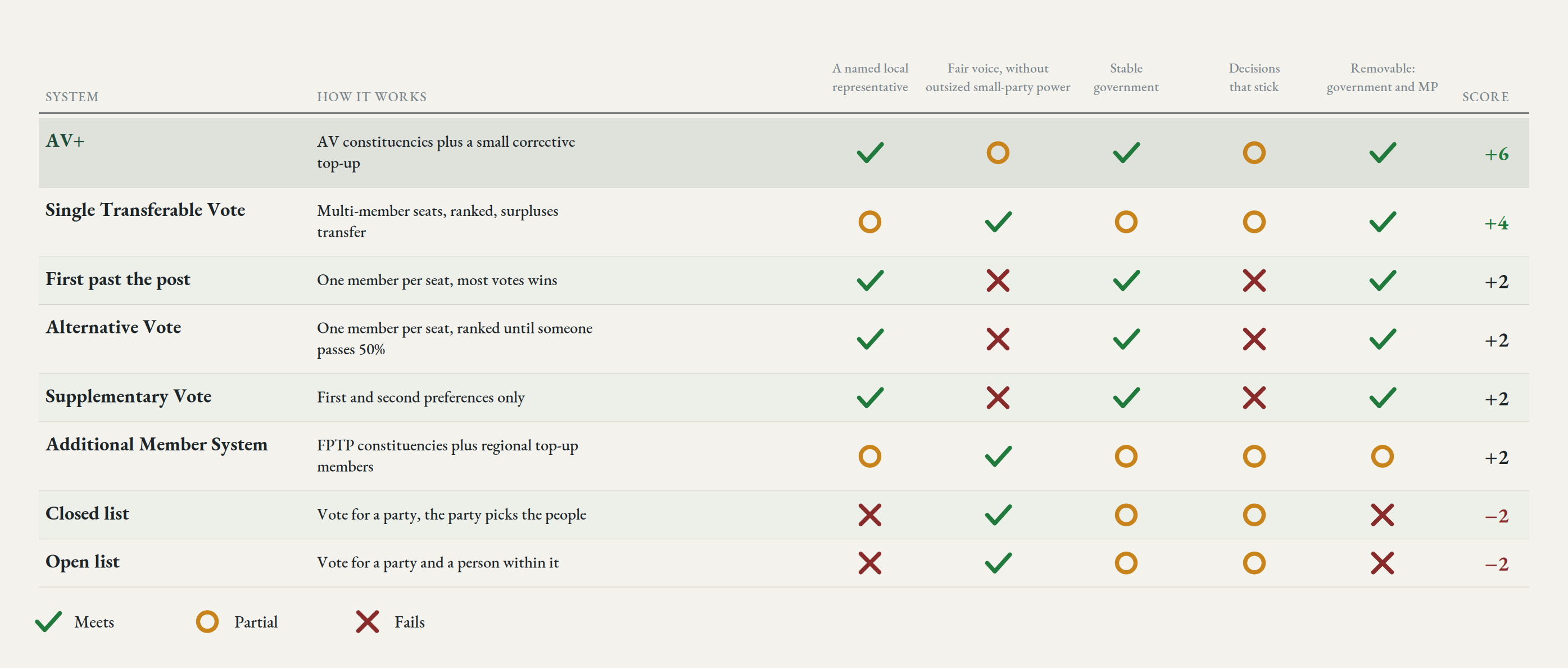
A named local representative. AV+ keeps a single named MP for your constituency, elected by a majority of those who voted there rather than the largest minority. The top-up member is attached to your county or city, not to a regional list of strangers.
A fair voice, without outsized small-party power. The corrective top-up removes the grossest distortions, where a party polls a fifth of the vote in a county and gets nothing. It does not go so far as to make a handful of members the permanent price of a majority.
Stable government. Single-party government remains the normal outcome. Jenkins designed it that way, and the simulations bear it out.
Decisions that stick. AV+ alone doesn’t deliver this, and I don’t claim it does. The long-term commitments framework does, by requiring two thirds of the Commons to create a national commitment and the same two thirds to revoke one. The big decisions framework does the same for constitutional and moral questions.
Removable: government and MP. A general election at least every five years removes a government. A by-election removes an individual MP, whether through resignation, death or recall. This is worth dwelling on, because it is the criterion most systems fail quietly. Under a closed-list system there is no by-election at all: when a member goes, the next name on the party’s list takes the seat, with no vote and no campaign. Andy Burnham is Prime Minister because he won the Makerfield by-election in June. The route he took back into Parliament does not exist under the purest form of the system he is proposing.
Summary
Start with the right question, which is this: how should we elect a House of Commons that is accountable, fair, stable, decisive, and removable, when every one of those four can be bought at the expense of the others?
Full-blooded PR answers one of the four and damages the rest. My fear is that we embark on another path we come to regret, and spend the following decade wishing for the good old days of FPTP and decisive Government, even when we didn’t agree with what it did. Let’s not do that.
AV+ comes out best. You keep your own MP, elected by a majority of your neighbours rather than a third of them. The county top-up corrects the worst of the unfairness. Single-party government continues to be the normal outcome. And every MP can still be removed by the people who sent them.
It’s the answer Roy Jenkins gave Tony Blair in 1998. Jenkins was widely recognised for his brilliance as a writer and historian, if not for his leadership of the SDP, and he was asked exactly the right question. Blair bottled it, having just won 179 seats on 43% of the vote in 1997.
But AV+ on its own isn’t the whole answer, because it doesn’t stop the next government undoing what the last one built. That needs the other two components: a new approach to long-term commitments, so a generation’s investment can’t be written off in an afternoon, and a new framework for taking big decisions, so the irreversible ones need more than a wafer-thin majority on a wet Wednesday.
Those three together answer the question in its entirety.
I commend the proposal to the House.