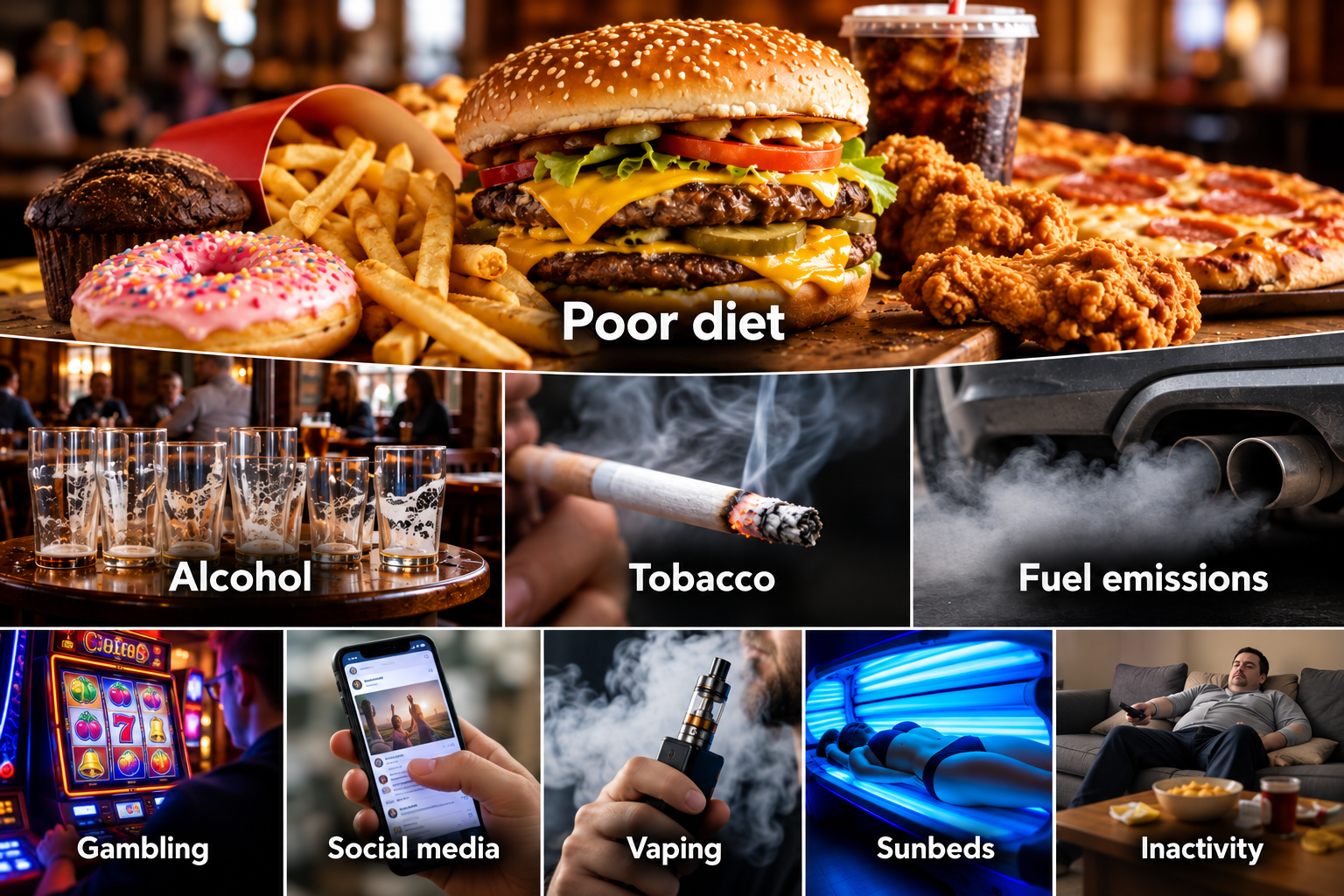
A new National Health & Wellness Levy will raise the money that’s needed for the new National Care Service and make a significant contribution to funding the NHS, in turn releasing money for other things like Defence.
No need to increase Income Tax or VAT.
Introduction
On 1 October 2026 a new tax came into force: the Vaping Products Duty. £2.20 on every 10ml of e-liquid, nicotine or not, paid by the manufacturers and importers rather than collected at the till. Tobacco duty went up the same day to keep vaping the cheaper option and prevent discouraging people from moving from tobacco to vapes.
It’s totally inconsistent with and doesn’t cohere with tax on other societal harms.
Nobody connected it to the biggest funding question in British politics. They should have, because the Treasury has just demonstrated exactly how to raise money from things that do harm, and it did it in a week when the country is arguing about how to pay for Care. Not, I note, about whether a Care Service is actually needed.
Andy Burnham admitted within 24 hours of his conference speech that the savings from the Pension Unlock may not cover the whole cost of a new National Care Service. Good to be clear and honest, quick out of the blocks, and close down a potential line of attack.
But the gap is real, and it isn’t the only one. There’s the NHS, which costs more every year because the population continues to age. And there are other bills queueing behind both, Defence among them, which I’ll come to another day and which will have to be funded another way.
Three huge costs, arriving at the same time, and no answer to any of them beyond a vague promise that the Government would “have to be honest and say where that money is coming from”. That’s an early signal that core taxes will rise to foot the bill.
I’ve got a better idea than that vaguery which solves a lot of problems. Yes, tax will have to increase but it can fall where it’s deserved and not equally on everyone.
How much is needed
The Care Service is estimated to cost around** £18.5 billion a year.** That’s the Health Foundation’s estimate for a service free at the point of use.
The NHS needs around £7 billion more every year, just to keep pace. The Department of Health and Social Care’s day-to-day budget is £202 billion in 2025-26 and £211.4 billion planned for 2026-27, a cash rise of 3.9%. But the long-run average increase in health spending is about 3.6% a year in real terms, and the OBR’s long-term projections run higher than that, because the population ages every year and the cost of treating it rises faster than the economy grows. On a £200 billion base, 3.6% is roughly £7 billion of additional real spending annually, compounding.
Some of that comes back. Burnham has pointed to NHS cashable savings from a functioning care system: fewer ambulance call-outs, fewer emergency admissions, fewer delayed discharges. Those savings are real and they are worth having, perhaps £1 billion to £2 billion a year once the system is running properly. They arrive slowly, they require the Care Service to exist first, and they do not touch the underlying demographic pressure. Call it a useful offset rather than a solution. Let’s call it a conservative £1bn a year. So £6bn a year more is needed for the NHS.
The Pension Unlock raises about £15 billion a year, but not for fourteen years. The government’s own figures show the savings building slowly from April 2030 and reaching that level around 2040. The Care Service is meant to start in the next Parliament. Let’s set that aside and look to use it elsewhere. The Triple Lock is unsustainable, and has served its purpose - to haul pensioners out of poverty which is very many of them where they were when it came in. (A lesson for politicians here: don’t make something permanent which is likely to have a time horizon or you’re stuck with it or at least you have to argue hard against changing it.) A Double Lock is a perfectly sensible next step, and after that a Single Lock of CPI increases only.
£18.5 billion is needed for Care, £6 billion a year and rising for the NHS.
That’s a total of £25 billion a year to be found in the next Parliament. And it grows. The NHS increment compounds: £6 billion more in the first year, £12 billion by the second, and so on. By the middle of the next decade, Care plus the accumulated NHS pressure is something like £70 billion a year. That’s a lot.
It feels like we’re being softened up for tax increases in National Insurance or Income Tax to pay for this. When push comes to shove, and we’re at election time, this may not be as palatable as the general notion that a Care Service and the NHS both need to be funded.
What we tax now, and what we don’t
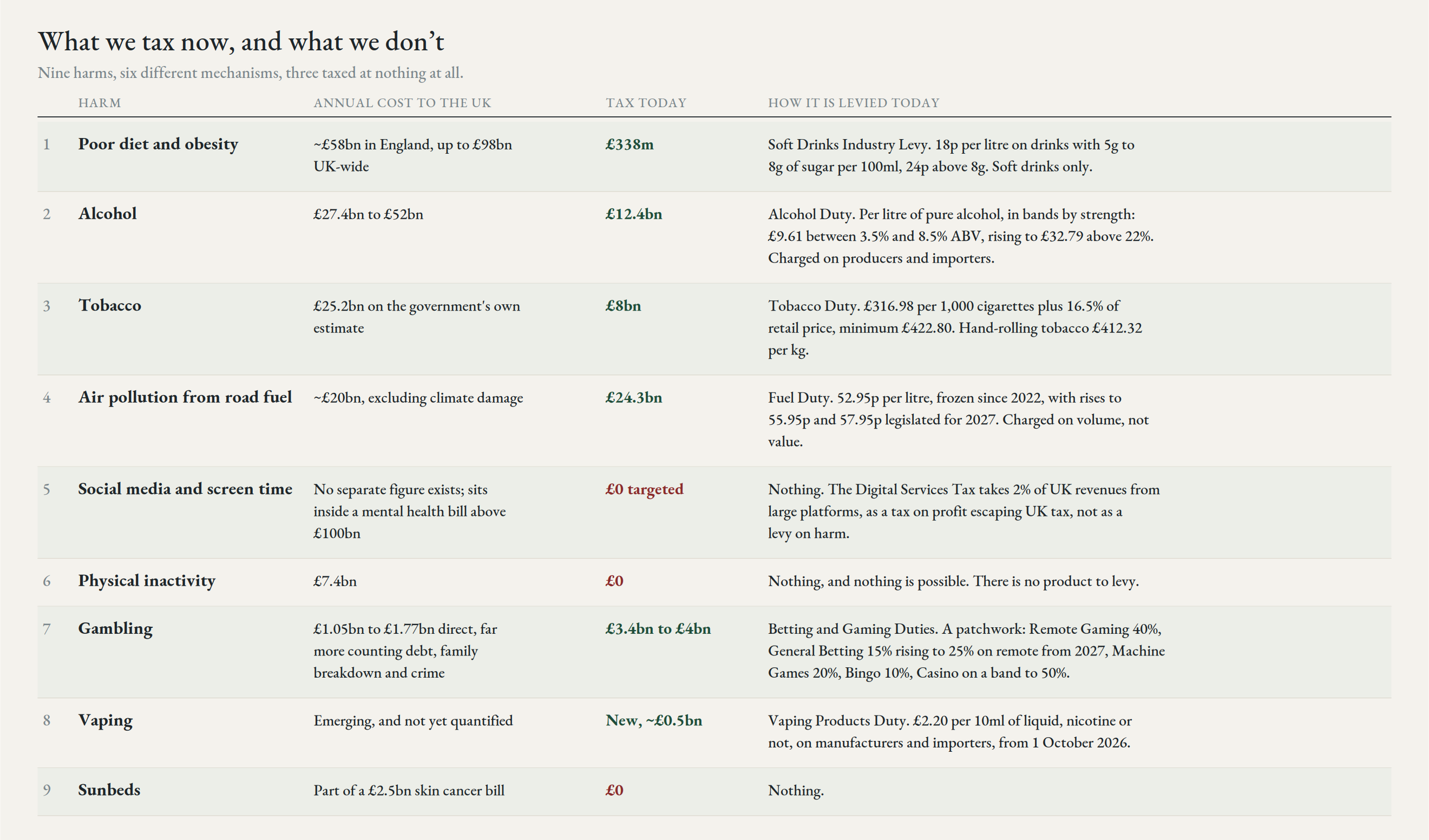
Here’s what the things that damage our health actually cost us, and what we currently collect from them.
Add it up and the gap is enormous. These harms cost Britain between £167 billion and £227 billion a year. We collect £48 billion against them. The shortfall runs to somewhere between £118 billion and £178 billion, every year, and it is paid by the NHS, by the care system, by employers through lost productivity, and by families. Three things stand out from this accounting.
One boulder, three stones and five pebbles. Poor diet is the boulder: on its own it costs more than everything else in the table put together, and it contributes £338 million, which is a fifth of one per cent of the harm it causes. Alcohol, tobacco and fuel are the stones: large harms, large taxes. Everything else is a pebble. Gambling, vaping, sunbeds, social media and inactivity are small in cost terms, and three of the five contribute nothing at all. Gambling is the one that already pays more than it costs.
So the problem is concentrated, which means the solution can be too. Deal with the boulder and the three stones and you have dealt with more than 90% of the measured harm.
Mechanisms are all different. Because these taxes arose from individual initiatives bolted on by a different Chancellor in a different decade for a different reason, there is no consistency or coherence. Sugar is taxed by grams per litre, but only in drinks. Alcohol by strength per litre. Tobacco by a per-thousand charge plus a share of price. Fuel by pence per litre. Vaping, as of this month, by millilitres of liquid.
Gambling is the one exception, and it is worth pausing on. It is taxed at five different rates on five different bases, which looks like the same incoherence. It isn’t. Remote gaming at 40 per cent, machines at 20, betting at 15, bingo at 10: those rates track, roughly, where the harm actually sits. Gambling is the only place in British tax where the principle I am arguing for is already applied. The rest of the table should follow it, not the other way round.
Some harms aren’t taxed at all including the biggest. Sunbeds. Social media. Most harmful food.
And one harm cannot be reached by any levy. Physical inactivity costs £7.4 billion a year, and there is no product, no supplier and no transaction to charge. It stays in the table because the cost is real, but it belongs to prevention spending rather than to taxation.
The solution
All harms which cost society in health and care included in the scope.
My preference is not for a nanny state that bans things. It’s for a system that loads cost into them, discouraging their use and raising revenue against the costs they create. Those who don’t indulge in them are no worse off. If the system discourages people from participating in them then tax take falls but so does the harm and its associated cost.
Nine rules.
1. A percentage of retail price. Not pence per litre, not pence per gram, not bands by strength.
A flat charge has to be argued about, legislated for and revisited as prices move, and set separately for every product in every category. Escalators are removed. What is the equivalent of 50p a pint for a sunbed session, a bet or a bag of crisps? There isn’t one, and inventing one for each is how we ended up with six different mechanisms.
A percentage needs no such argument. It applies identically to a £4 pint, a £10 sunbed session, and an £18 pack of cigarettes. It rises with prices automatically, so it never erodes and never needs a Budget to maintain it. And the administrative cost is minimised, because almost every business in the country already calculates a percentage of its sale price for VAT. This runs on the same machinery.
2. Paid by the supplier, meaning whoever puts the product into the UK market: the manufacturer, the importer, the operator, the platform.
Charge it on profit and the big integrated companies will move margin around. An oil major, a drinks group or a tobacco company that owns its own supply chain would simply shift profit upstream, out of the taxed layer, and avoid the levy. Charge it where the product enters the market and there’s nowhere upstream to go.
It’s also far cheaper to collect. A few hundred significant suppliers, against hundreds of thousands of retailers, and HMRC already deals with the suppliers for duty purposes.
And it leaves the pricing decision with the company. They can pass it on, absorb it, or reformulate products to reduce it. The sugar levy showed what happens: most manufacturers cut the sugar rather than pay the tax. That’s the better outcome, and it happened without a single ban.
3. The same rate everywhere, with one exception where the harm is concentrated in one product. The alternative, in general, is a negotiation, and a negotiation is a lobbying contest that the best-funded industry wins. That is precisely how we got a system where food pays almost nothing.
The exception is gambling, and the evidence for it is overwhelming. Problem gamblers are 0.8 per cent of the population and generate a quarter of online industry profits. Counting those at risk, around 5 per cent of gamblers produce about 60 per cent of online profits, and the top tenth of gamblers by spend account for roughly 60 per cent of all industry revenue. The harm does not sit in gambling. It sits in particular products.
So gambling is charged in two tiers. The lottery, bingo, the pools and betting on sport and racing pay the common rate of 10 per cent. Online casino, slots and high-intensity machines pay 40 per cent.
That is a tax cut for most people who gamble. Lottery duty is 12 per cent today and general betting duty 15, with remote betting legislated to rise to 25 per cent in 2027. All of that comes down to 10 and the rise is cancelled. Machine games duty goes up from 20 to 40 to match the online rate.
This is not a tax on having a flutter. I am cutting the tax on the lottery, on bingo and on a bet on the Grand National, because none of those is doing anyone much harm. I am raising it on the online slot machine, because that is where the damage is.
4. 10% to begin with, rising to 20%. The World Health Organization’s threshold for actually changing behaviour is 20% of retail price. Below that, the evidence shows consumption barely moves. More than 50 jurisdictions now use it.
Colombia is the working model: a tax on ultra-processed food at 10% in 2023, 15% in 2024 and 20% in 2025. Mexico’s non-essential food tax is 8%. And for tobacco the WHO recommends a tax share of 75% of retail price, which the UK already meets. Nobody calls that tyranny, and it’s nearly four times what I’m proposing.
5. The levy is a floor, not a ceiling. Where an existing duty already charges more than the common rate, it stays where it is.
This matters more than it sounds. Tobacco is taxed at around 75% of retail price and should remain so. Remote gaming duty rose from 21% to 40% in April 2026, deliberately, because online casino games are the most harmful product in the sector. Dropping either of those to 20% would be a tax cut for the two most damaging industries in the country, which is the opposite of the point.
So the rule is: 10% rising to 20% is the minimum that every harm pays. Where Parliament has already decided a harm deserves more, more is what it pays. The levy sweeps up everything currently taxed at nothing, or taxed at less than the floor, and leaves the heavier duties alone.
6. Fuel is the one exception, and stays a flat rate per litre. Everything else in the levy is a percentage. Fuel is not, for one simple reason.
A percentage of the pump price rises automatically whenever oil prices spike, which is precisely when motorists can least afford it. Diesel passed 200p a litre for the first time this month. Under a percentage levy the tax would have climbed with it, amplifying the pain rather than cushioning it. The current pence-per-litre duty does the opposite, and that is worth keeping.
So fuel stays at 52.95p a litre, uprated each year in line with the Consumer Prices Index, automatically and without a Budget ritual. No freeze, no escalator, no annual argument. The duty holds its real value and nothing more.
Dropping it to 10% overnight would hand motorists £18 billion, leaving a hole in the tax take roughly the size of the entire Care Service. So that doesn’t work, although we do want fuel and energy costs down to help individuals be better off and businesses be more globally competitive. We will need Iran, the Yemenis, the US and Saudi Arabia to resolve the conflicts that have constrained supply and pushed up prices.
As the fleet electrifies and the base shrinks, the flat rate converges on the common percentage, and by the time the petrol engine is gone the exception has disappeared with it.
A share of fuel duty receipts** will move to the health pot, because the harm is real and now well evidenced.**
The Royal College of Physicians published A Breath of Fresh Air in June 2025. It found that air pollution now affects almost every organ in the body, contributes to the equivalent of 30,000 deaths a year in the UK, and costs more than £27 billion annually in healthcare, lost productivity and reduced quality of life. Counting wider effects such as dementia, the figure may be as high as £50 billion. It shortens life expectancy by an average of 1.8 years, which puts it just behind smoking and cancer among the leading causes of death and disease worldwide. There is no safe level of it.
And it falls hardest on the people who did least to cause it. People living in the 20% most deprived areas of England breathe air with 8% higher concentrations of fine particulates than those in the least deprived fifth. Non-white communities experience 83% higher nitrogen dioxide and 27% higher particulates than the white population. The RCP’s own conclusion is that the most deprived communities typically contribute least to emissions and suffer the worst health outcomes from them.
That is the fairness argument for this levy in a sentence. The people who buy the fuel are not, in the main, the people breathing the worst of what comes out of it.
Road transport is the largest single contributor in the places where most people live, through exhaust emissions and, increasingly, through tyre and brake particulates, which now account for the majority of traffic-related particulate matter and which electric vehicles produce too.
So fuel pays into the health pot like everything else, at the same rate. The equivalent of 10% of the pump price at the introductory rate, rising to 20%, goes to the National Health & Wellness Fund. The remainder of fuel duty continues to flow to general taxation exactly as it does now.
In cash terms that is £6.2 billion to the Fund at 10%, leaving £18.1 billion in general taxation, and £12.4 billion to the Fund at 20%, leaving £11.9 billion. Set against perhaps £9 billion of road-attributable health cost, even the full rate is charging less than the harm.
General taxation gives up £6.2 billion, rising to £12.4 billion, and that will have to be found elsewhere.
As the fleet electrifies, the fuel base shrinks. Motoring taxes raise about £33 billion a year, £24.4 billion from fuel duty and £8.4 billion from Vehicle Excise Duty, and the OBR expects fuel duty receipts to halve to around £12 billion in real terms during the 2030s and approach zero by 2050. The electric vehicle excise duty announced for April 2028, at 3p a mile for battery cars, offsets around a quarter of that loss. Three quarters of it is unanswered.
Electricity is taxed, but nothing like as heavily, which is the whole problem. A litre of petrol at 174.8p carries 52.95p of fuel duty and about 29p of VAT: roughly 82p of tax, or around 10p for every mile driven. The same journey in an electric car charged at home uses about 2.4 kilowatt hours, costing around 60p, carrying 5% VAT: about 3p of tax, or under half a penny a mile. So the driver who switches to electric pays roughly a twentieth of the tax per mile. Rising electricity use recovers a fraction of what is lost, not an offset.
That is a question about how we pay for roads and for the use of them, not about how we pay for harm. I’ll tackle it in a future paper.
7. Unhealthy food is defined by the nutrient profiling model we already use to decide what can be advertised to children and promoted at the end of supermarket aisles. Not a new definition. One that’s already law.
That model already reaches beyond the supermarket shelf. Calorie labelling rules have applied to restaurants, cafés and takeaways with 250 or more employees since 2022, so the machinery for assessing out-of-home food exists and the businesses already comply with it. The levy follows the same boundary: the large chains are in, the independent café and the village chip shop are out. Greggs is in scope. The baker on the high street is not.
That line is drawn where it is for practical reasons. A small independent cannot be asked to run a nutrient profiling assessment on every product, and the revenue from doing so would not cover the cost of collecting it.
8. Hypothecated, and reported. The levy goes into a National Health & Wellness Fund, reported separately every year, showing what was raised by category and where it went.
The National Care Service is funded first, up to its full cost, because it’s new, it has no existing budget line, and it’s the thing people are being asked to pay for. The balance goes to the NHS, and specifically to prevention: the services that reduce the harms being taxed in the first place.
If the levy ever raises less because consumption falls, that’s success, not failure. The costs fall with it. And because care has first call, the thing people were promised is the last thing to be squeezed.
9. Nothing is banned. If you want a pint, a bet, a cigarette or a takeaway, nobody is stopping you. People who don’t buy these things pay nothing.
Want to legalise some drugs, by the way? Go ahead and wrap them in. The structure is ready, and the revenue arrives on day one.
This new Levy isn’t a penalty on the less well-off for having “fun”, nor is it a moralistic tax on things that are “bad”. It is neither a “fun tax” nor a “sin tax” before anyone goes labelling it that way. It is a charge for harm on multi-billion-pound industries that profit by extracting wealth and health from vulnerable areas that goes towards addressing the effect.
Fairness demands that we should prevent companies from making cheap profits from making communities sick.
We know that taxes can result in improvements in products that are sold. When the Soft Drinks Industry Levy or “Sugar Tax” came in, manufacturers did not simply pass the cost onto consumers. They reformulated their recipes to reduce sugar content and avoid the tax.
The less well-off are more likely to consume these harms and spend a larger share of their income on them. The result is a double whammy. They lose their disposable income to these industries, and then they lose their health, which destroys their ability to work and traps them in a cycle of deprivation.
The wealthiest contribute to the levy disproportionately because they spend far more in absolute cash terms on premium alcohol, high-end processed foods, and fuel. And in this way it is a progressive tax with the wealthy subsidising the healthcare and care of the less well-off.
What it raises
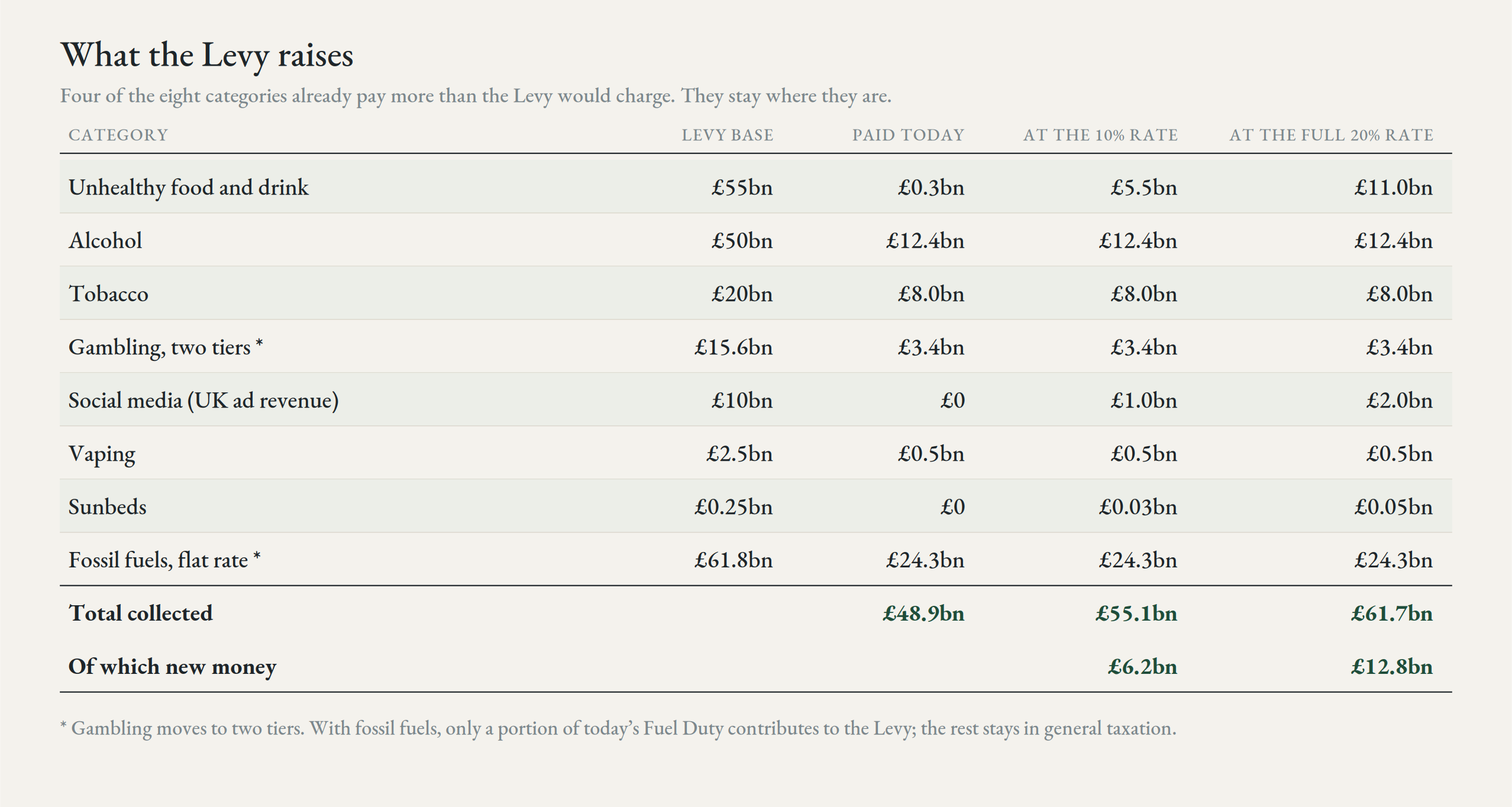
Market sizes below are central estimates rather than forecasts. The contribution that food makes will depend on where the nutrient profiling line is drawn so that figure is a target value.
With Fossil fuels, only a portion of today’s Fuel Duty will contribute to the new Levy. The rest stays in general taxation.
The “paid today” column is the honest part, and it changes the headline. Alcohol and tobacco already pay more than a 20 per cent levy would charge them: £12.4 billion and £8 billion, against bases of £50 billion and £20 billion. Under the floor rule they stay exactly where they are. The same is true of gambling and of fuel. So the levy raises no new money at all from four of the eight categories. What it does is bring them inside one framework, on one principle, with one collection point.
The new money comes from the categories currently paying nothing or next to nothing: unhealthy food, social media, sunbeds and, marginally, vaping. That is £6.2 billion at the introductory rate and £12.8 billion at the full rate.
The Fund also takes the equivalent of the common rate from fuel, £6.2 billion at 10 per cent and £12.4 billion at 20, with the rest of fuel duty staying in general taxation as it does now.
So the money reaching Care and the NHS is £12.4 billion at the introductory rate and £25.2 billion at the full rate.
At the full 20%, the Levy puts £25.2 billion a year into Care and the NHS. Set that against the £25 billion a year this country needs to find in the next Parliament, and the arithmetic works without touching Income Tax, National Insurance or VAT.
It is a close-run thing rather than a comfortable surplus, and it only works at the full rate. At the introductory rate it covers two thirds of the Care Service and nothing else. This is a five-year project, not a first-Budget one.
I have ignored the value of the Pension Unlock. Its £15 billion arrives slowly and reaches full value around 2040 and can be used elsewhere.
A sense of scale. At 10%, a £5 pint goes up 50p, a £3 bag of crisps by 30p, a £12 bottle of wine by £1.20. Less than prices moved last year on their own. At 20% it will be £1 on a pint, 60p on a bag of crisps, £2.40 on a bottle of wine.
Implementation
Two years to consult, legislate, and for business to prepare: the definitions, particularly for food, and the collection machinery.
Year one: food, alcohol and tobacco. Together they represent 82% of the base and around 90% of the measured harm. These businesses already have duty systems and HMRC relationships making transition easier for them.
Year two: fuel, gambling and social media. Fuel keeps its flat rate per litre, now uprated annually by CPI, so motorists see no immediate change. No temporary freezes, which have turned into semi-permanent freezes, required. Gambling moves to its two tiers: duty on the lottery, bingo, pools and sports betting falls to the common rate, and machine games duty rises to match the 40 per cent already charged on online casino. Social media is the one genuinely new collection, and it can follow the Digital Services Tax model, which already works.
Year three: vaping and sunbeds. Under 2% of the base, but they complete the principle. Vaping converts from the duty introduced this October to the common percentage.
Rates start at 10% and step to 20% over the five years following the start in each of these groups, on a published schedule, so that every business can plan and no consumer is surprised.
Summary
We have two big funding requirements arriving at the same time: a National Care Service, and the relentless annual increase in the cost of the NHS. Something like £25 billion a year in the next Parliament, and growing.
We have a system of harm taxes that nobody designed so they’re inconsistent and incoherent. Sugar is taxed in drinks but not in food, and sunbeds, social media and most of the food that makes us less healthy pay nothing at all. Only gambling is taxed in a way that tracks the harm it does, and even there the rates were arrived at by accident rather than design.
The answer. A Health & Wellness Levy on everything that causes societal harm and costs the NHS and Social Care. One rate. Charged on suppliers of all societal harms as a percentage of retail price. 10% rising to 20%, as a floor rather than a ceiling, so that where a harm already pays more it continues to. Fuel folded in at a flat rate per litre, uprated by CPI. Hypothecated to Care first and the NHS second, and reported every year so people can see how much and where it goes.
£12 billion a year into Care and the NHS to start, rising to £25 billion at the full rate. Four of the eight categories pay no more than they do today; the new money comes from the harms that currently pay nothing.
Nothing is banned. If you don’t drink, smoke, gamble, vape, tan or live on ultra-processed food, you pay nothing at all.
Finally the things that drive many of the burdens borne by Health and Care services finally start paying for them.
𝚃𝚑𝚎 𝙾𝚗𝚎 𝙼𝚊𝚗 𝚃𝚑𝚒𝚗𝚔 𝚃𝚊𝚗𝚔
Notes
Tax alone will not fix machine addiction, and the premises have a part to play. A pub that keeps serving someone who has obviously had too much can lose its licence. The same duty of care should apply to the venue hosting a bank of Category B machines: it knows who is there every afternoon, it knows who is chasing losses, and at present it has every commercial reason to say nothing. That is a licensing question rather than a tax one, so it sits outside this paper, but a levy that prices the harm and a licence that polices the premises belong together.