Education · 28 Sep 2026
Education Isn’t Working

Education isn’t equipping children with the life skills or the work skills they really need. It isn’t helping employers select the right people for their open positions. It is focused on teaching knowledge, not how to get things done.
Introduction
The single strongest predictor of job performance ever measured is not an exam grade or a degree class. It is the structured competency interview, which has become the predominant interview technique for employers.
It works on a simple idea. Ask a candidate for a specific occasion: the situation, the task they were given, the action they personally took, and the result. Past behaviour in a comparable situation predicts future behaviour well. Asking what people would do in a certain situation only tells you who can answer the question well, not what they would actually do in those circumstances. Hypothetical questions are a poor predictor of future behaviour.
Now test a school leaver. Ask them to describe a situation where they carried responsibility, took action, and produced a result they can measure. Most have nothing to say.
Not because they are incapable. Because nobody has ever given them the chance.
Before competency interviewing, the orthodoxy was that academic exam success predicted performance best. But the children coming out of top schools and universities who got the best jobs had two things, not one. They had the exam results, and they had competence built from their experience in those institutions: being a prefect, running a club or marketing it, being responsible for its finances. Only one of those two things appeared on the certificate.
Research now puts competency interviewing at the top of the table. Second is empirically keyed biodata. That’s a biographical questionnaire of factual questions about people’s past. It too uses past behaviour as a predictor of future performance. And third is the work sample test, using actual performance as a predictor of future performance. The unstructured interview, by contrast, is a poor predictor. That confirms what was already known from employer experience and has ensured the proliferation of competency interviewing as a selection tool.
The implication for schools is uncomfortable. We assess children for eleven years using the method that predicts least well, and then employers re-assess them on arrival using the method that predicts best. The examination system is not merely an imperfect proxy for capability. It is measuring a different thing.
I don’t want to argue that learning and knowing things isn’t useful or important. It absolutely is. I fully support the requirement for English, Maths and Science. These are foundational knowledge that’s good for work and life. In the case of science there is some valuable how alongside the knowledge. Experiments to test hypotheses for example. I also support the availability and re-balancing of academic, applied and technical qualifications. But I’m focused on the gap that’s left in children’s preparation for life and work.
Six findings shape my thinking.
The gap is real and employers name it precisely. In the 2024 Employer Skills Survey, 69 per cent of skill-shortage vacancies were caused at least in part by a lack of people and personal skills. Complex problem solving was a factor in 45 per cent, up from 36 per cent two years earlier.
Current reform intent does not close it. The Francis Review, chaired by Professor Becky Francis of the Education Endowment Foundation and published in November 2025 after 16 months of work, is explicitly evolutionary. It adds an oracy framework, financial literacy content and citizenship in primary. Oracy, if you’re not familiar with the word and I wasn’t in spite of my very fine education, is the ability to express one’s thoughts clearly and communicate them effectively through spoken language, active listening and meaningful dialogue. The Review doesn’t change what gets assessed though, and that’s where the incentives actually lie.
Competency frameworks converge. Employers, the World Economic Forum, the civil service and the professions describe broadly the same eight to twelve behaviours in different words. That convergence is what makes a curriculum spine possible.
Financial competence is the clearest life gap, and the one where the UK has the weakest provision relative to stated policy.
A second language is collapsing, and it is becoming a private school subject. Entries have roughly halved since the requirement to study one to 16 was dropped in 2004. French is down 63 per cent since 2002 and German down 67 per cent. Uptake is 20 percentage points lower in poorer areas than in affluent ones, and the Francis Review has just scrapped the EBacc, which was the main thing propping it up.
Assessment is the binding constraint, not curriculum. Every competency-based reform that has failed has failed here. Any proposal that does not have an assessment answer is a wish.
From this I take away three things. Schools should assess what employers assess, because that method predicts real performance better than anything else we have, and we are declining to use it on the people it would help most. A second language should be compulsory to 16, chosen from the seven that reach the most people in the most places, and taught by people who actually speak it. And life competencies need rounding out, specifying, and assessing too.
1. The diagnosis
The English school system is optimised for one thing, and it does that thing well. Better than ever now, and for all children. The proportion of six year olds meeting the phonics standard has risen by more than twenty percentage points since 2012. England now ranks fourth in the world for primary reading, having been eighth a decade ago. Literacy and numeracy among 16 to 24 year olds improved more here between 2011 and 2021 than in any other country measured. Absolute scores wobbled through Covid, as they did everywhere, but against the rest of the world England has been climbing for fifteen years.
Which is exactly why the gap I am describing matters. We have proved we can raise a standard when we decide to measure it.
What the system does is teach a body of knowledge and then test recall and application of that knowledge under timed conditions, individually, without reference material, without collaboration, and without any requirement to produce anything anybody actually wants.
How often do you hear it said that exam results feel so important at the time, but shortly afterwards they’re largely irrelevant? I’ve said it to my children.
Many of the conditions of academic assessment are vastly different from work. A lot of work these days is collaborative. It’s open book. It has deadlines, but rarely only one bite at the cherry. You’re judged on output more than process. And it isn’t reliant on being asked a question to which somebody already knows the answer. If they knew, they wouldn’t ask.
This is not an accident and it is not stupidity. Written examination is cheap, scalable, defensible against appeal, and relatively hard to corrupt. It produces a number that universities and employers can sort by. The system optimises for reliability of measurement, and it achieves it. The problem is that the thing it measures reliably is not the thing that matters most.
As I’ve said above, the Francis Review recommends a new statutory oracy framework across primary and secondary, which is a direct admission that verbal communication has been undertaught. It adds financial literacy content and media literacy against misinformation. It makes citizenship compulsory in primary. It scraps the English Baccalaureate performance measure. It cuts Key Stage 4 examination time by at least 10 per cent, which the DfE has translated into roughly 2.5 to 3 hours less per average student. It retains and strengthens the three-route model of academic, applied and technical qualifications.
But the Review is a curriculum review. It changes what is taught and trims how long the examinations last. It does not change what is assessed or how, and in a high-stakes system assessment is the only instrument with real force.
Schools are judged on results. Teachers teach what is examined. Add oracy to the curriculum without examining it and you have added an aspiration to a document. Every experienced head will tell you the same thing: if it is not in the accountability measure, it is the first thing dropped in March.
So the deficiency is sharper than “knowing rather than doing”. It is this: we have built an assessment system that can only see one kind of evidence, and then designed a curriculum around what that system can see. The tail wags the dog, and the Review leaves the tail intact.
Knowledge is not the enemy of competence, it is the substrate of it. You cannot think critically about a subject you know nothing about, and the research on this is fairly settled. I am not anti-knowledge.
And schools are not only for work. Preparation for employment is one purpose among several, alongside civic formation, cultural inheritance and the intrinsic case for an educated population.
The Eton problem
This is the part of the argument I can make from the inside, and it is the reason the paper cannot be about money.
I was a scholar at Eton College. The education was as good as education gets: taught by specialists, in small groups, by people who knew their subject completely, were totally passionate and even obsessive about it, and expected you to keep up.
The extra-curricular facilities and options are very diverse in arts, music and sport. The Farrer Theatre: a highly sophisticated 400-seat auditorium featuring a full counterweight flying system, orchestra pit, scenic workshop, massive wardrobe department, and professional sound and lighting rigs. Not the only performance space. A drama department employing five full-time theatre professionals, including an Artistic Director, a Resident Designer and a Filmmaker-in-Residence. Multiple pupil-led publications. Drawing schools, museums, exhibition spaces. A 25-metre, 8-lane competition swimming pool with an adjustable floor, alongside a multi-purpose four-court sports hall. Countless playing fields and courts. Orchestras, bands, four organs of the highest quality, two chapels, choirs, tuition in a huge variety of instruments. A professional recording studio, music technology suites, rock and drum studios, concert halls. I’ve doubtless missed something out.
These facilities are not merely good, they are beyond what most professional institutions have.
I edited the Eton College Chronicle for a term, which was the tenure, and contributed for a couple of years before that. We were served dinner in a fifteenth century hall by butlers in tails. In the forty years since, I have eaten one meal in comparable surroundings. Once.
Eton is other-worldly, and very little that comes after it compares.
The obvious lesson is the wrong one. It is tempting to conclude that the problem is the remoteness: that such a magnificent school cannot prepare anyone for ordinary life, and that the answer is more contact with reality. That is true as far as it goes, but it is not the useful insight.
The useful insight is the opposite one. Eton indirectly teaches competencies better than very many schools in the country. Not through a competency curriculum, and not through assessment. Through the extra-curricular activities.
Oracy, written argument, analytical reasoning, self-management, collaboration: all of it is delivered, along with the confidence built by those experiences, and none of it appears on a certificate.
None of it was assessed. Nobody at Eton sat an examination in running a newspaper. The competencies were built anyway, because the school was arranged so that they happened to everybody, every term, for five years. That is a design, not a luxury, and most of it costs nothing but timetable and intent.
So the competency curriculum this paper argues for already exists to some extent. It is simply not available to most people. We’ve pulled up academic standards for all, and now it’s time to do the same for competencies and give every child the best start in life. The gap between a school with forty societies and a rowing lake and a school that cancels its French GCSE when numbers drop is not primarily a gap in teaching quality. It is a gap in everything that happens around the teaching, which is exactly where competencies are formed.
A worry about competency assessment is that it would reward the confident and the coached, and therefore widen the class gap. You could say the same about academic education. The answer is that the class gap in competencies already exists, at full width, and is currently invisible because we do not measure it. Employers measure it, at 22, using structured interviews, and act on what they find. We simply decline to do anything about it while there is still time.
2. What employers actually look for
Competency based interviewing rests on a simple premise: past behaviour in a comparable situation predicts future behaviour better than stated intention does. Ask for a specific instance, probe the situation, the task, the action and the result, score against defined behavioural anchors, repeat across interviewers.
Employers have told us what job candidates are missing
The Employer Skills Survey 2024 covers 22,712 employers across the UK and is the best domestic evidence available.
On skill-shortage vacancies, close to 9 in 10 were caused at least in part by a lack of technical and practical skills, and 7 in 10 by a lack of people and personal skills. The largest increases since 2022 were in solving complex problems, a factor in 45 per cent of shortage vacancies against 36 per cent two years earlier, and advanced or specialist IT skills at 25 per cent against 17 per cent.
On existing staff, complex analytical skills were lacking in 44 per cent of skills gaps, with complex problem solving at 38 per cent and complex numerical or statistical skills at 20 per cent.
The WEF Future of Jobs Report 2025, covering over 1,000 employers across 55 economies, ranks core skills by the share of employers calling them essential: analytical thinking 69 per cent, resilience, flexibility and agility 67 per cent, leadership and social influence 61 per cent, creative thinking 57 per cent, motivation and self-awareness 52 per cent, technological literacy 51 per cent, empathy and active listening 50 per cent, curiosity and lifelong learning 50 per cent.
As an aside, the same report lists reading, writing and mathematics among the skills declining in importance. Not because literacy and numeracy have stopped being important, but because employers increasingly assume them and value what sits on top.
3. The top 10 workplace competencies
The useful fact is that frameworks converge. The Civil Service Success Profiles, the NHS Leadership Framework, graduate scheme frameworks across the professions, the WEF list and the typical corporate model all describe roughly the same behaviours in different vocabulary. Where independent parties working separately arrive at the same set, we can be confident we have the right answer.
There are ten, grouped into three families. The grouping is useful because it could map onto how the competencies would be developed and assessed.
Communication
1. Verbal communication. Explaining something complex to someone who does not share your background. Speaking to a room. Being understood first time. This is now partly conceded in policy through the oracy framework, which makes it the easiest to argue for and the natural lead example.
2. Written communication. Not essay writing. Writing to be acted on: the email, the brief, the proposal, the summary of a meeting, the one-page recommendation. English GCSE teaches literary analysis and rhetorical construction. Almost nobody at work writes either.
3. Listening and questioning. The most undertaught and, in my experience of interviewing, the most reliably diagnostic. Most weak candidates answer the question they expected rather than the one asked. The WEF has empathy and active listening at 50 per cent of employers.
Thinking
4. Analytical reasoning. Breaking a problem into parts, identifying what is actually being asked, working out what evidence would settle it. Top of every employer list. Analytical thinking leads the WEF ranking at 69 per cent.
5. Numerical competence. Not mathematics. Percentages, proportion, compounding, orders of magnitude, reading a chart and table, spotting an implausible number, understanding what a statistic does not say. Maths GCSE covers quadratic equations and leaves many people unable to sanity-check an invoice.
6. Judgement under uncertainty. Deciding with incomplete information, on a deadline, knowing the decision may be wrong. School trains the opposite: every question has an answer, the answer is knowable, and being wrong is penalised rather than informative. There is more scope for it in the humanities, where the answer is argued rather than marked right, but they are losing ground. At A-level in 2025, history fell 5.5 per cent, its second consecutive annual drop, English literature fell 4.4 per cent and geography 5.5 per cent, while maths, further maths and physics grew. At GCSE the EBacc has so far held history and geography steady, and the Francis Review has now scrapped it.
7. Digital and information competence. Evaluating a source, using the tools, and now working with and checking AI output. The Review’s computing revamp and media literacy content touch this.
Working alone and with others
8. Collaboration. Producing a joint output where the contributions are genuinely interdependent. Schools mostly treat collaboration as cheating, although some project work requires collaboration.
9. Resilience and adaptability. Second on the WEF list at 67 per cent and up 17 points since the previous report. The hardest to teach directly and the most likely to be taught through how a school operates rather than through a lesson.
10. Self-management. Prioritisation, planning backwards from a deadline, knowing your own reliability. The competency most obviously developable and least obviously developed.
4. The top 5 life competencies
The ten above are key to work but also of benefit to life in general. Five things are additional, and they share a characteristic. Everybody agrees they matter, nobody is accountable for them, so they do not happen.
1. Financial competence. The clearest gap and the one that damages most people.
Financial education has technically been in the English national curriculum since 2014, inside citizenship and mathematics. In practice citizenship is barely taught in primaries, squeezed in secondaries, and academies are not required to follow the national curriculum at all, which covers most secondary schools. The Francis Review adds financial literacy content, which is welcome and does not fix the accountability problem.
What it should contain, roughly in order of how many people it harms:
Borrowing. APR, what compounding does over time, the difference between a mortgage, a credit card, an overdraft and buy-now-pay-later, and what happens when you miss a payment
Asking. Negotiating pay, querying a bill, challenging a charge, complaining effectively, and knowing that most prices and many decisions are negotiable. The most neglected item on this list, because it sits between financial education and assertiveness and is owned by neither
Earning and deductions. Reading a payslip, income tax and National Insurance, marginal rate traps, what self-employment actually involves
Pensions and compounding. Why the first ten years of contributions matter more than the last twenty
Insurance and risk. What to insure, what to carry yourself, why the cheapest policy often is not the best one
2. Contracts, small print and fraud. Tenancy and employment agreements, subscriptions, cancellation rights, and what you are actually agreeing to. Fraud is now among the most common crimes in the country and is almost entirely absent from schooling. Separated from financial competence because it is a different skill: one is about money, this is about reading what somebody has written and assessing whether it’s fair, exploitative, or plain fraudulent.
3. Civic and institutional navigation. How to vote and for what, how local government differs from national, how planning works, how to complain to a council and what a councillor actually does, how the courts work. More broadly, the transferable skill of working out who decides a thing and how to reach them. The Review makes citizenship compulsory in primary, which is an advance, although teaching it in a classroom is not as powerful as, for example, pupils electing prefects based on manifestos.
4. Health and self-maintenance. Nutrition, exercise, sleep, alcohol, and specifically how to use the health system: registering with a GP, using 111, preparing for an appointment, knowing what to expect. Plus mental health literacy, which is well covered in policy and variably in practice.
5. Relationships and conflict. Disagreeing without escalating, giving and receiving criticism, negotiating, resolving, repairing things after they go wrong, and the ordinary maintenance of friendships and family. Overlaps with RSHE, relationships, sex and health education, and is the hardest to write about without sounding either preachy or naive.
The pattern across all five. These are the classic orphan subjects. The failure mode is identical every time: added to the curriculum, not assessed, nobody accountable, first casualty of a crowded timetable in March. Any recommendation that stops at “put it in the curriculum” has learned nothing from thirty years of trying.
5. Everyone needs a second language
Why it matters
Some people will tell you a second language is a waste of curriculum time now that a phone can translate a menu. They are wrong, and not for sentimental reasons.
You cannot negotiate through an app. You cannot build trust through one, or catch the aside that tells you the deal is in trouble, or be the person in the room the other side would rather deal with. Britain exports to countries whose languages we have stopped teaching, and we send people to do it who can only work in English, and only with people who can too.
It’s fair to say that the number of English speakers and the quality of English spoken continues to rise in the world. But effective interactions, understanding nuance, are done in the mother tongue.
Beyond work: living somewhere rather than visiting it. Reading a writer as written rather than as rendered. Watching a country’s news rather than somebody’s summary of it. And the thing nobody mentions, which is that learning any second language teaches you that your own is one option among many, with its own peculiar way of cutting up the world. That is not a translation problem, and no machine gives it to you.
Google Translate, simultaneous translation and translate-from-image are all hugely beneficial. They work for the menu on holiday. They do not work for the relationship.
The UK position
In 2004 the requirement to study a language to 16 was removed. Before that, roughly three quarters of young people took a language GCSE, with 318,000 entries for French, 122,000 for German and 64,000 for Spanish. By 2010 it was 43 per cent. The EBacc pulled it back to around 45 per cent and it has stuck there.
The HEPI report of July 2025 gives the current picture. French GCSE entries are down 63 per cent since 2002 and German down 67 per cent. Only 2.97 per cent of A-levels taken in 2024 were in modern foreign languages, classical subjects, Welsh as a second language or Irish, and there are now more A-level entries for PE than for French, German and classical languages combined. Language teacher recruitment hit 43 per cent of target in 2024. Twenty-eight universities have closed modern languages degrees, 17 of them since 2014.
There is also a class dimension that strengthens the argument considerably. The proportion of Year 11 pupils studying a language for GCSE is around 20 percentage points lower in poorer areas than in affluent ones. Two thirds of secondary schools cancel language classes when numbers are low, most often in lower-income areas. Language learning is quietly becoming a private school subject.
And the Francis Review has just scrapped the EBacc, which was the main thing propping up the 45 per cent. There is a real risk that uptake falls further from here, which makes this a timely argument rather than a perennial one.
What is compulsory now, and what I would change
In England the national curriculum applies to maintained schools but not to academies, which is most secondaries. Its core subjects, English, maths and science, are compulsory from 5 to 16. A foreign language is compulsory only at Key Stage 2, ages 7 to 11, and Key Stage 3, ages 11 to 14. It is optional at GCSE. Also compulsory from 14 to 16 are PE, citizenship, computing, religious education, and relationships, sex and health education. Since 2015, everyone must stay in education or training until 18, though not necessarily at school.
What I propose is a restoration rather than an invention: a language compulsory to 16, alongside English and maths, exactly as it was until 2004. Chosen from the seven below.
The list of languages needs rebuilding for today
I’ve used three factors, explicitly weighted. Speakers at 50 per cent, because the first purpose of a language is the number of people it reaches. Country spread at 30 per cent, measured by official status, because a language confined to one state is a narrower asset. Proximity and practicability at 20 per cent, because the nearer a country the more likely people from the UK are to travel to it or interact with it.
Proximity is scored by judgement on a 0 to 10 scale, combining distance, travel cost and trade exposure.
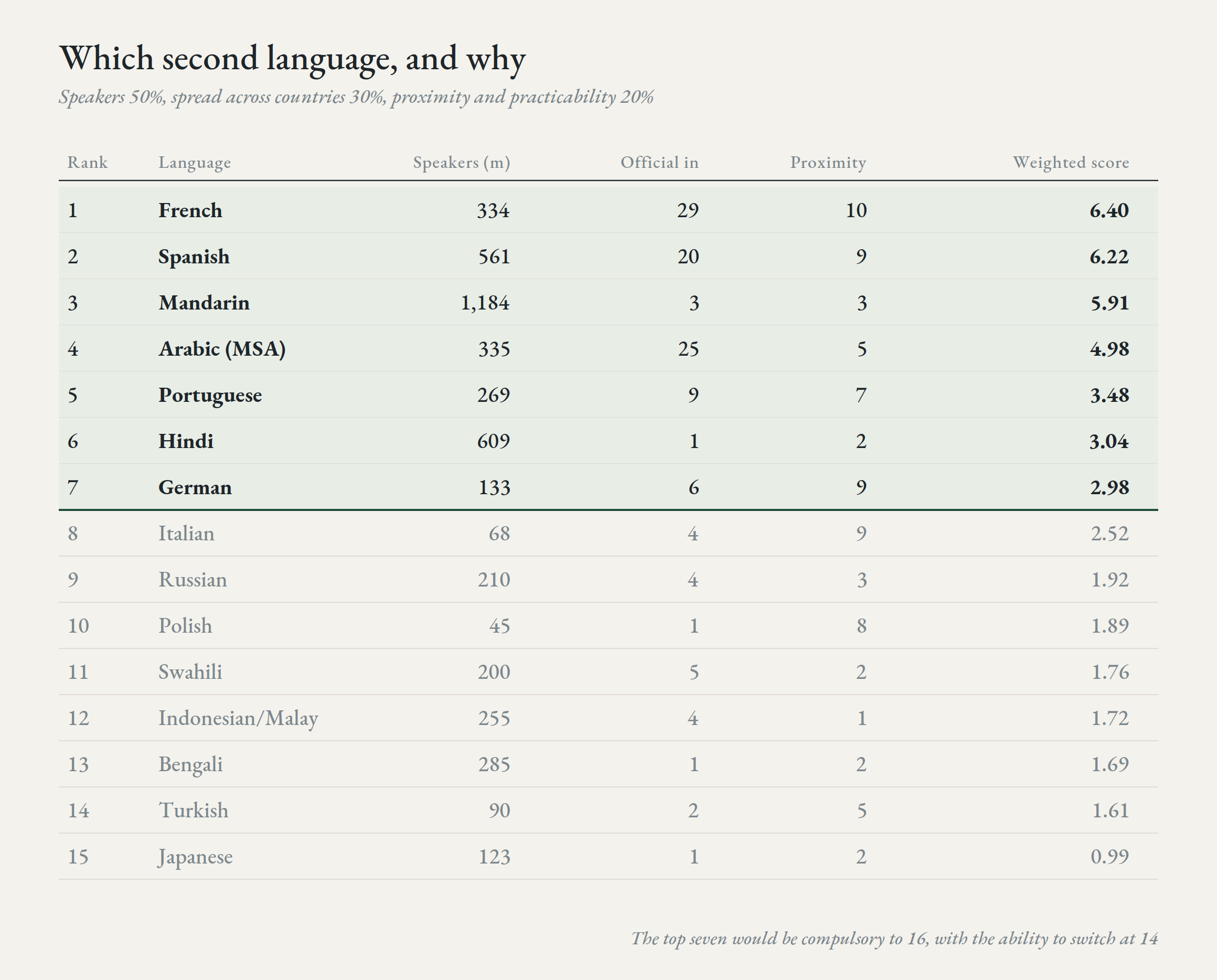
I would take the top seven - French, Spanish, Mandarin, Arabic, Portuguese, Hindi and German - and make it compulsory to study one of them to 16, with the ability to switch at 14.
We will need teachers, and better language teaching
Half of the top seven have almost no teaching capacity in the UK currently, and recruitment is already at 43 per cent of target for the languages we do teach. We should target native speakers who want to teach their language in the UK, and give them visas.
Nor is the problem only supply. Nearly a quarter of primary schools have nobody qualified beyond GCSE in the language they teach. Most primary teachers have had no language-specific training in the past year. Ofsted has found language lessons that fail to challenge or engage, with more low-level disruption than in other subjects. And the handover at 11 is so poor that many children effectively start again, having spent four years on a language they are then taught from scratch.
Fix the supply, fix the transition, and teach it as something you speak rather than something you revise.
6. Build a repertoire, don’t run classes
This is the design decision that makes this proposal workable.
Competency lessons would be timetabled at low status, handed to whoever has a free period, resented for the time they take from everything else, and dropped in Year 11. Worse, they would not work. You cannot transmit a competency by describing it, any more than you can learn to swim in a seminar.
What a young person needs is not instruction in teamwork. It is a set of real situations in which they carried responsibility and produced a result. That comes from three places at once: academic learning, where the extended project, the experiment that fails and the essay defended under questioning all qualify; vocational and technical learning, which is already built this way; and everything around the teaching, which is where Eton and others do their real work.
So where does the time come from? It doesn’t. That is the point. Almost none of this is new provision, and none of it is a new subject. The extended project already exists. The school play already exists. The team, the society, the Saturday job and the expedition already exist. What is missing is that nobody treats them as the point, and nobody keeps the record.
The change is not adding a lesson. It is deciding that what happens around the lessons is not decoration.
7. Assessment
If the competencies aren’t assessed, they won’t get done. Simple as that. Teachers teach what is examined, schools are judged on what is measured, and everything else is the first thing dropped in March.
No one wants another exam, and another exam would not work anyway. You cannot sit a two-hour paper in judgement under uncertainty. So pupils accumulate evidence of competence over time themselves in a journal or online repository: specific situations, what they were responsible for, what they did, and what resulted. Pupils accumulate this evidence across five years, assessed against behavioural anchors, sampled and moderated externally so that the record means the same thing in Barnsley as in Barnes.
Annual reviews are done by schools. In the last two years of sixth form, independent assessors conduct the annual reviews. It gives every 17 year old two rehearsals of the interview that will shape their working life, which at present only the coached and the well-connected get.
It is in their interests to ensure that children are appropriately prepared. Independent assessors will do it at no cost to the school. Employers will do it. Some schools already use parents to run mock interviews for university applicants, and the same approach works here: parents with the relevant professional experience, trained on the anchors, reviewing pupils who are not their own. Between employers, parents, governors and alumni, most schools already know enough suitable adults. What they have never had is a reason to organise them.
And we already run assessment like this at scale elsewhere. Every apprenticeship in the country ends with an independent end-point assessment against an occupational standard, judged by an external assessor rather than the trainer. T Levels are built the same way, around a 45-day industry placement. Thousands of schools already use the Skills Builder framework, which breaks eight essential skills into sixteen progressive steps. The machinery exists. It has simply never been pointed at every child.
The result is reported separately from academic grades, never blended into a single number. Blending is how the softer measure gets quietly discounted.
Conclusion
English schools teach knowledge better than they ever have. Rebalancing between academic, applied and technical knowledge is a great thing. That is a real achievement and I am not asking anyone to undo it. But knowledge was never the whole job, and the rest of it is currently delivered by accident, unevenly, and mostly to children whose schools and families can arrange it.
So three changes.
Name the competencies and build them through what schools already do. Ten for work, five for life. Not a new subject, not a new lesson, and not a new slot in a timetable that has none. Through the extended project, the play, the team, the society and the job, treated as the point rather than as decoration, with a record kept from 11 to 18.
Assess them, or none of it will happen. A pupil-built record of real situations, reviewed annually by the school, and in the last two years by employers, parents and others with the right professional experience. Moderated externally. Reported separately from academic grades.
Make a second language compulsory to 16 again, chosen from the seven that reach the most people in the most places, taught by people who speak it, and handed over properly at 11 instead of started again.
Get it piloted asap. None of this needs a decade of consultation before anybody tries it. Take a reasonable number of schools, varied by intake and region, and run the competency framework and the assessment model properly for a cohort. At the same time, find the schools that already achieve high uptake of a language to GCSE, because they exist, and work out what they are doing that everybody else isn’t. Publish both. Then scale what works.
We have spent fifteen years proving that this country can raise a standard when it decides to measure one. The competencies that actually predict how a young person will fare at work, and in life, are still not measured at all. That is the gap, and it is a choice.
Next time: the role a New National Service can play.
Photo by Waseem Farooq from PxHere
Education
Comments (0)
Loading comments…