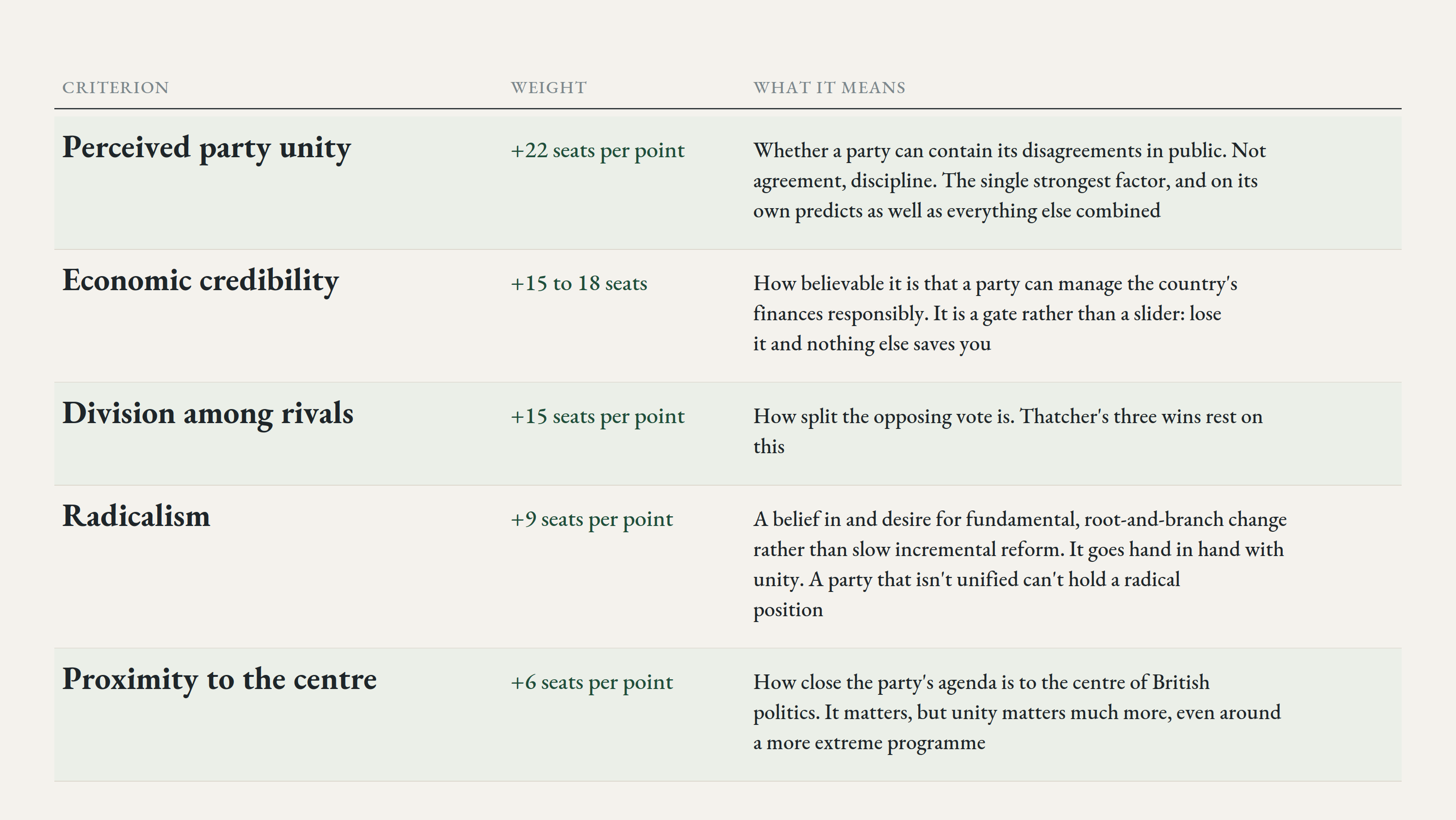
I’ve analysed every General Election since 1979 to see if I can determine what a winning position looks like.
What doesn’t matter much, despite what one may have assumed, is:
How much people are struggling, combining inflation with unemployment. It correlates with the size of a majority at minus 0.07.
The feel-good factor, GDP growth in the election year. +0.30 i.e. adding it to the model makes the predictions worse.
Incumbent fatigue, how long a party has been in power. Half a seat of majority per year in office. Fifteen years buys the opposition about eight seats.
Leader charisma. It improves the fit to the past and worsens the prediction; the signature of a variable that explains nothing.
Leader charisma relative to the opponent. Better, and still beaten by party unity.
Turnout, which includes therefore the time of year/weather. Nothing.
Third party vote share. It explains 11% of the variation, the worst of everything tested.
So here’s what really matters.
On economic credibility, note that in all twelve elections since 1979, the party with the better economic reputation won.
It's about reputation, not actually about the economy. In 1992 Britain was in recession and the Conservatives still won. In 1997 the economy was strong and improving and they were destroyed, because Black Wednesday had undermined their credibility and they never recovered it. In 1983 unemployment was above three million and Thatcher won by 144 seats.
Where votes for a party are matters more than how many they have. In 1983 the SDP-Liberal Alliance took 25.4 per cent of the vote and 23 seats. Labour took 27.6 per cent and 209. Two points of difference, 186 seats apart. Meanwhile in 2024 Labour won the second largest majority of the modern era on 33.7 per cent, the lowest winning share ever recorded. Blair in 1997 took 43.2 per cent and won seven more seats than Starmer did on nine and a half points less.
In summary
To win a General Election a party needs to look united, be trusted with the economy, hope its opponents split, hold a radical position, move towards the centre, and have its votes in the right places.
𝚃𝚑𝚎 𝙾𝚗𝚎 𝙼𝚊𝚗 𝚃𝚑𝚒𝚗𝚔 𝚃𝚊𝚗𝚔
Next time: how were the parties positioned on these criteria a year ago, and where are they now after the conference season? Quite a lot has changed..