But not as you know it
Last time I argued that school teaches children to know things rather than to do things, and that the clearest evidence is the competency interview every serious employer now uses. Ask a school leaver to describe a situation where they carried responsibility, took action and produced a result they can measure, and most have nothing to say.
Not because they are incapable. Because nobody has ever given them the chance.
This piece is about where that chance should come from.
School can do more, and it should. But there is a limit to what any classroom can provide, however good. In a classroom the situation is controlled, the task is set, the action is prescribed and the result is a grade. Some competencies can be developed: teamwork, written and oral communication. Many can’t. So children can’t build much of a repertoire of real responsibility inside an institution designed, for the most part, to remove it.
Something has to sit between school and work. For a generation, two things did: National Service and Apprenticeships.
From 1949 to 1960 young British men were called up for National Service, and for the best part of two years the state gave them responsibility, discipline, and a barrack room shared with people they would never otherwise have met. It ended in 1960. Nothing has replaced it.
Apprenticeships lasted longer, but they have been in decline too. For most of the last century an apprenticeship was the normal route into skilled work for a school leaver, and apprenticeships shrank with the industries that offered them. They were revived as Modern Apprenticeships in the 1990s and reached a modern peak of 521,000 starts in England in 2010/11. Then the 2017 Apprenticeship Levy knocked them back. There were 353,500 starts in 2024/25, around 155,000 fewer than in the year before the levy began. They have also drifted away from the young: only 21 per cent of starts are now by under-19s, and more than half are by people aged 25 or over. There is a modest revival under way, with starts up almost 9 per cent so far this year. But an apprenticeship is no longer what school leavers do. It is increasingly what employers do for staff they already have.
For 60 years we have just left children with a significant gap in their education and preparation for life and work.
And more young people are falling into that gap than at any time in more than a decade. In the first three months of 2026, more than 1 million people aged 16 to 24 were not in education, employment or training. It was the first time the figure had passed a million since 2013, and most of the increase was, worryingly, young men.
My answer is a New National Service. Not the one your grandfather did. Not the one Rishi Sunak announced during the 2024 election campaign. Something designed from the start to do what school cannot: give every young person real responsibility, real results, and real contact with people unlike themselves.
School just can’t supply everything children need
A repertoire. Competency interviews run on STAR: the Situation, the Task, the Action you personally took, and the Result. A good candidate has twenty or thirty real examples to draw on. A typical school leaver has a Duke of Edinburgh expedition if they are lucky and a part-time job if they are unlucky enough to need one. The ones who interview well are the ones whose families got them experiences. That is not a skills gap. It is a distribution problem.
A year of genuine responsibility changes the arithmetic completely. Run a shift. Manage a budget. Get a flood barrier up before the river peaks. Keep a frightened old man calm at three in the morning. Every one of those is a STAR answer, and every one of them is something a school cannot arrange.
Being depended on. At school, when a child fails, the cost falls on the child. A missed deadline means a lower mark. Nobody else goes without. Work is the opposite: the shift nobody covers, the patient who waits, the team that misses its target because one person did not turn up. Learning that other people are relying on you, and behaving accordingly, is the single most important thing most people learn in their first job. A classroom cannot teach it, because a classroom is built so that nobody depends on a child for anything.
A mixed milieu. The single most valuable thing Eton gave me was not the teaching or the facilities. It was the company. Most of my contemporaries were born into the ruling class; I arrived as a poor scholar from a working-class background and left inside a tent my grandparents would not even recognise. That network is positional, and no curriculum reform will ever distribute it.
But there is a weaker, more democratic version of the same thing, and post-war National Service delivered it almost by accident. For two years the grammar school boy, the miner’s son and the heir to an estate slept in the same hut, ate the same food and were shouted at by the same corporal. Nobody designed that as social policy. It was simply what happened when a whole generation was put through the same institution.
We have nothing like it now. We sort children by postcode at 4, by ability at 11, by subject at 16 and by university at 18, and then express surprise that the country does not understand itself.
Employers already see and name the gap
None of this is news to business. In 2014 the British Chambers of Commerce surveyed almost 3,000 firms: 88 per cent said school leavers were unprepared for work, and 54 per cent said the same of graduates. Three quarters named lack of work experience as a key reason.
Twelve years on, the complaint has not gone away. A survey of 500 small and medium-sized employers in June 2026 found 44 per cent saying that most or almost all school leavers are not ready for work.
The most useful finding comes from the other side of the argument. When the UK Commission for Employment and Skills pushed back against the Chambers in 2014, it pointed out that employers who actually hire young people are mostly satisfied with them, and that where they are not, the problem is usually a lack of experience rather than a lack of skills or knowledge.
That is the whole case in a sentence. Young people are not short of ability. They are short of experience, and we have built a system that gives them none.
Why now?
The current situation has persisted for decades. Three things make it urgent.
Defence. In my last piece but one I argued that Britain’s hold on the South Atlantic has rested for 44 years on American support, and that the support can no longer be assumed. Asked recently whether the US would help defend the Falklands, Donald Trump said it was a long way away. RAF Akrotiri was hit by an Iranian-made drone in March 2026. Britain signed up in 2025 to NATO’s target of 5 per cent of GDP on defence and resilience by 2035, and the regular Army is smaller than at any point in more than 200 years.
Russia is no longer a distant concern. For three years it has run a campaign of sabotage, arson, cyberattacks and drone incursions across Europe that stops just short of war. This week, Poland’s prime minister told his parliament that intelligence assessments suggest Russia may launch drone or missile attacks on NATO territory within months, disguised as accidents, to show that Article 5 is more theoretical than practical. German intelligence says Moscow is building the option of a war with NATO by 2029. Finnish military intelligence expects the Russian forces near Finland’s border could double or even triple, with a new army corps being raised in Karelia. Last month the director of the CIA flew to Moscow to warn the Kremlin off the Baltic states.
And the Americans are telling us, in writing, that we are increasingly on our own. The US National Defense Strategy published in January 2026 makes Europe responsible for its own conventional defence, with only “critical but more limited” American support, and describes America’s allies as “freeloading dependents”. In May 2026, Washington announced the withdrawal of 5,000 troops from Germany. This is not just Trump. Britain fought for more than two years before the United States entered the Second World War, and America came in only when Japan attacked Pearl Harbor. In 1940, Churchill had to trade 99-year, rent-free leases on British bases in Bermuda, Newfoundland and the Caribbean for 50 elderly American destroyers. American help has always had to be worked for, and it has always arrived late.
A country that expects to be on its own more often, without a superpower guaranteeing its security, needs more people who know what to do when things go wrong. Not only soldiers. Paramedics, firefighters, flood wardens, drone operators, logisticians, and a population that has at least once been trained to respond rather than watch.
Europe is already moving. Nine EU member states now conscript. Germany’s new military service came into force on 1 January 2026. Every 18-year-old man must complete a questionnaire, and Berlin has kept the option of compulsion if volunteers fall short. France is introducing a paid, 10-month voluntary military service during 2026, starting with 3,000 and aiming for 50,000 a year by 2035. Belgium’s voluntary scheme is due to start this autumn. Denmark has extended conscription to women and lengthened it from four months to eleven.
Britain, meanwhile, has gone the other way. We closed the National Citizen Service in March 2025, after more than £1.5 billion and 14 years. What replaced it, on the defence side, is a military gap year opening to a laughable 150 young people in 2026.
A country that does not know itself. The Union of the Isles argument rests on the observation that the four nations of these islands have drifted into mutual incomprehension. Young people in Glasgow, Cardiff, Belfast and Barnsley share a passport and very little else. A national institution that deliberately mixed them, across class and across the four nations, would do more for the union, or for whatever succeeds it, than any number of constitutional commissions.
And there are a million young people currently doing nothing at all. That is not a statistic. It is a generation drifting past the point at which drift becomes permanent.
What has been tried, and what it teaches
Nostalgia is not an argument, and the evidence on national service is more mixed than its champions admit. It is worth going through properly, because the failures are specific and they point straight at the right design.
The National Citizen Service ran from 2011 to 2025. At its peak it was reaching around 178,000 16 and 17-year-olds a year, for two to four weeks, at somewhere between £1,400 and £1,900 a head. Participants liked it: 84 per cent said they would recommend it. It never once hit its participation targets, and the National Audit Office could never say whether it achieved anything lasting. It was voluntary, which meant the young people who most needed it were the least likely to turn up, and it was short, which meant nothing much could happen.
Rishi Sunak’s 2024 proposal would have required every 18-year-old either to apply for one of 30,000 selective military places or to volunteer for 25 days over a year, at a cost of about £2.5 billion. Twenty-five days is a month of weekends. It was widely read as an election gimmick, and the Army made clear it had neither the capacity nor the appetite to absorb it.
France’s Service National Universel was a fortnight’s residential stay followed by a short placement, launched with great ambition in 2019 and meant to become universal by 2026. It has now been replaced by the paid 10-month military service. The lesson Paris drew is that a fortnight changes nothing.
No economic uplift after conscription. Britain’s own post-war National Service had no measurable effect on the later earnings of the men who did it. A Danish study using the random draft lottery found that peacetime service reduced lifetime earnings, by about $23,000 for high-ability men, but not at all for low-ability men. Recent Swedish evidence finds conscripts more likely to be unemployed until their mid-20s and earning less after 30. A Swedish study also found that service increased later offending among disadvantaged young men who already had a criminal record. The Economics Observatory’s summary is that compelling evidence for conscription as a “school of the nation” remains elusive.
What the evidence actually says is narrower than it looks. It is about military conscription, not national service in general. The earnings penalty runs mainly through one mechanism: disrupted education, falling hardest on the young people with the most to lose. It does not fall on those with the least. And the Swedish finding on crime is an argument against putting young men with records in a barracks together and teaching them to fight, which nobody should need a study to establish as a likely outcome.
Read properly, the evidence does not say national service fails. It says four specific things fail:
- Schemes that are too short to give anyone real responsibility
- Schemes that are voluntary, so they miss the people who need them most
- Schemes that interrupt education at the worst possible moment, so the able pay the price
- Schemes that treat drill and obedience as the point, rather than competence
Each of those is a design choice. Each can be designed out.
What a New National Service looks like
Ten design choices. Each answers a specific failure.
1. Compulsory, for everyone. Every young person does one year of national service between the ages of 17 and 21. Not an offer, not an opt-out. An obligation.
This is the choice that matters most, and I make it deliberately. Voluntary schemes reach the wrong people: NCS never met a single participation target, because the young people who most needed it were the least likely to sign up. And mixing up people from across the country, and gaining a social cohesion benefit from it, only works if everybody is in. A scheme the heir to an estate can decline is not a scheme that puts him in a room with the lad from Merthyr.
We already accept the principle. Since 2015, young people in England have been required to stay in education or training until 18. This is one more year, of a different kind.
The only exemptions are the ones any serious system needs: serious illness or disability, full-time caring responsibilities, and custodial sentences. Together, something like 15 per cent of a cohort.
2. A full year, September to August, in one place. Twelve months, full time, matching the academic calendar. Each person chooses one track at the start and stays in it for the year. No mixing and matching. A fortnight is an activity holiday. Twenty-five days is a hobby. A year is a meaningful time to gain experience and learn, long enough to be trusted with something real and to be judged on how you handled it.
3. Any year between 17 and 21. The timing is the young person’s choice. Straight after school. A gap year before university. A sandwich year in the middle of a degree, exactly as industrial placements work now. Or immediately after graduating. Where possible, placements match the degree: the medical student on a ward, the engineering student with the Navy, the computing student in cyber defence. The earnings penalty observed in other countries came from interrupting education at the wrong moment. This lets every young person pick the right moment.
4. An apprenticeship counts. A recognised apprenticeship of at least 12 months discharges the obligation in full. Service is meant to prepare people for work, and an apprentice is already doing exactly that. No young person should have to choose between a career and their country.
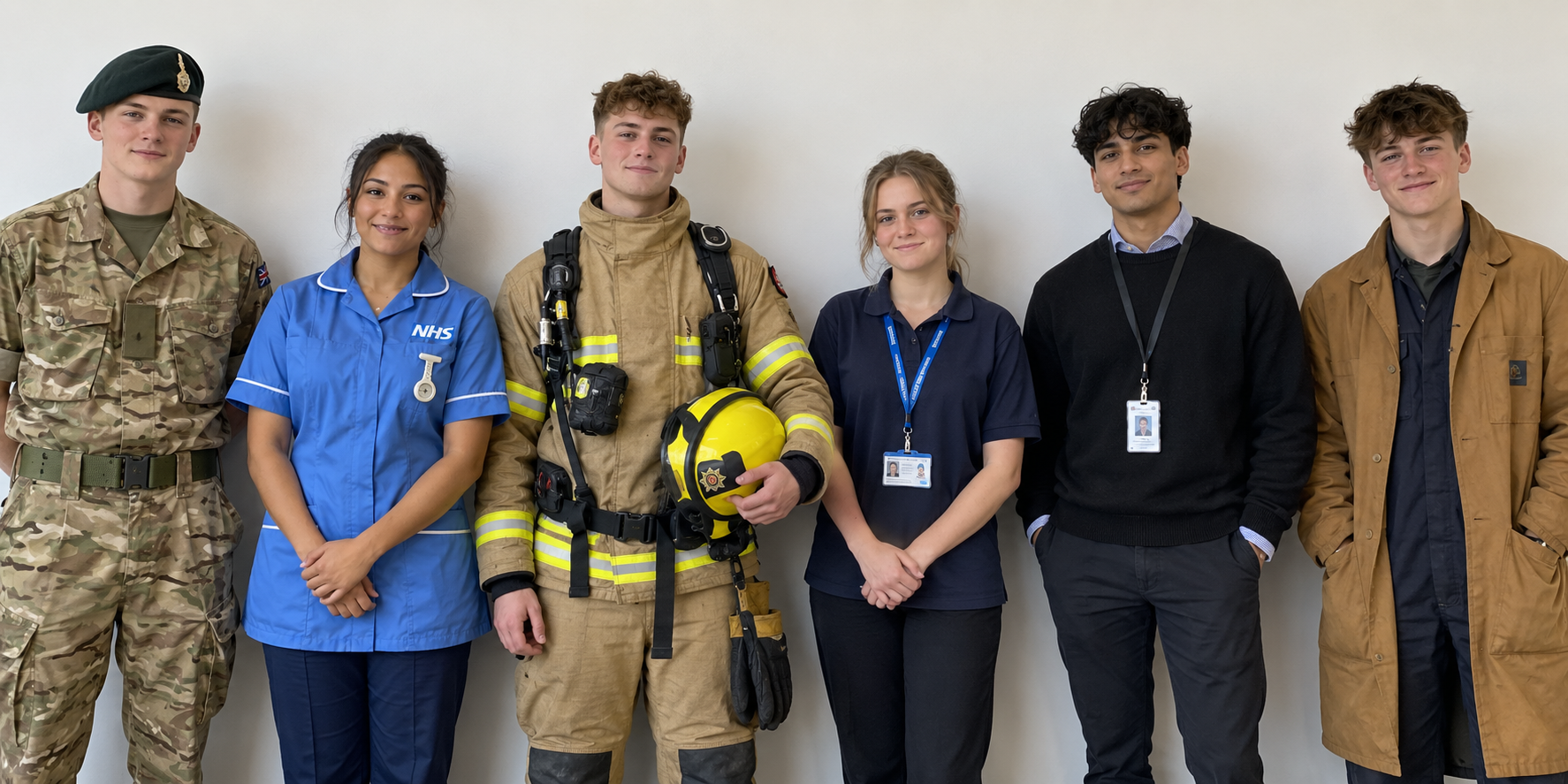
5. Where it is served. Six broad areas, and a real choice between them:
The Armed Forces, all three services, with around 30,000 places a year. The Forces choose whom they take, as Sweden and Norway do, and are not used as a dumping ground
Public services: the NHS, ambulance, fire and police support roles, social care and local councils
Charities: the major registered charities, in conservation, humanitarian work, and community support
Education: classroom and special needs support in the schools that most need help, which is how this series comes full circle
Cyber and digital: public sector systems, digital inclusion for older people, and entry-level roles in national cyber defence
Climate and resilience: flood defence, retrofitting homes, forestry, and the physical work of preparing the country for harsher weather
Every placement is additional to the paid workforce, never a substitute for it, on the same principle that stops apprentices being used as cheap labour.
6. Paid properly, and the military paid more. A standard civic stipend of £14,000 for the year. The military track pays £19,500, because three months of basic training, barracks life and round-the-clock readiness are a harder year, and the Forces should be able to attract the best. Accommodation and food come with the military track.
Part of each is held back as a completion bonus. Civic participants receive £950 a month and £2,600 on completion; military participants £1,300 a month and £3,900 on completion. The bonus rewards finishing, which is the whole point.
7. Nobody walks out. Once a year of service has begun, it is finished. The only exception is serious illness, injury or disability, in which case the participant keeps everything paid so far and receives a proportion of the bonus.
Walk out, or be dismissed for misconduct, and the bonus is forfeit. Everything paid to date becomes a debt to the state, repaid through the tax system on the same terms as a student loan. Until repayment begins, there are civil sanctions, such as suspension of a driving licence. This is not punitive for its own sake. It is what every employer who sponsors a degree or pays a golden hello already does.
8. A residential start, deliberately mixed. Every track begins with residential induction, which for the military is basic training. Cohorts are mixed by background and by nation. A young woman from Kensington and a young man from Merthyr sharing a dormitory in Fife is not an accident of the design. It is the design.
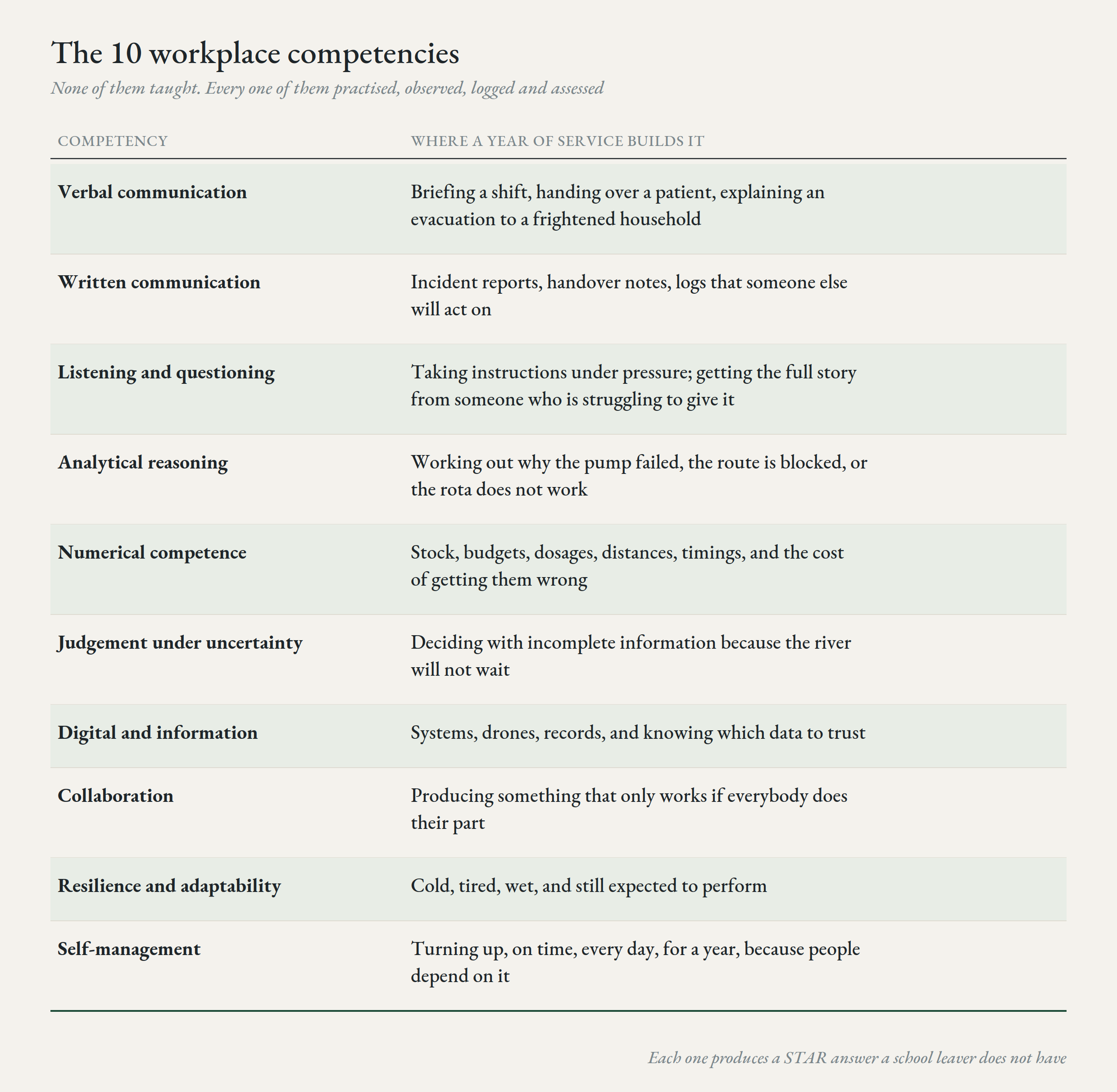
9. Everyone leaves with a record, and a meaningful certificate of completion. Throughout the year, each participant logs their STAR examples with their supervisor, month by month. One afternoon a week is set aside for training towards recognised qualifications: emergency first aid, health and safety, data protection, cyber security basics, project management foundations, practical AI and data skills, personal finance, and mental health first aid.
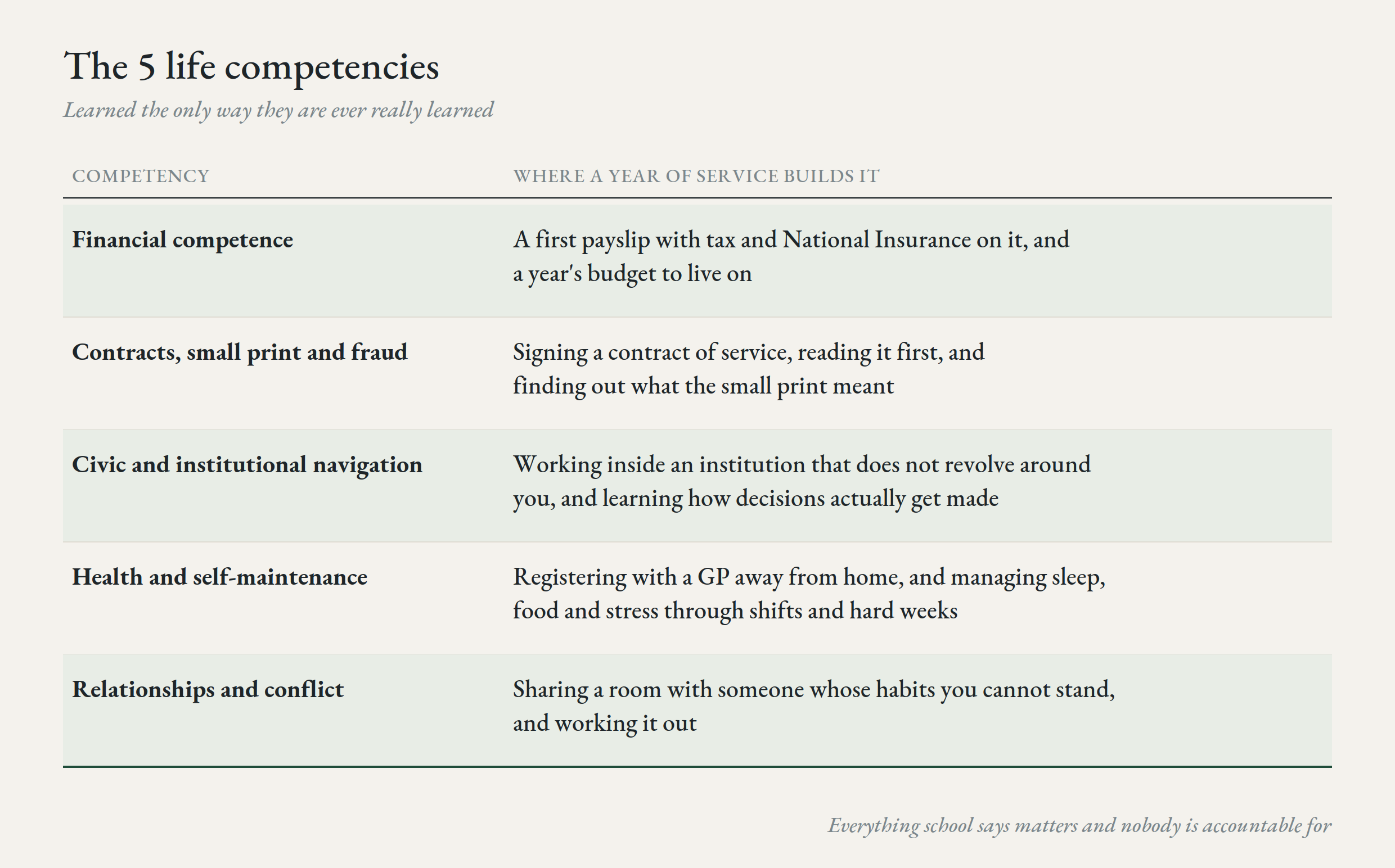
At the end, they sit the structured competency interview I proposed in the education piece, with an external assessor, scored against the 15 competencies for work and life. They leave with a National Service Certificate: a standard record of what they did, what they achieved, what they are certified in, and how reliably they turned up. Employers get a credential they can trust. Universities get UCAS points. Every public body guarantees an interview.
10. Phased in from September 2030. After a two-year voluntary pilot, and built up in stages. How that works is set out below.
What it builds
In the education piece I named the top 10 workplace competencies and the top 5 life ones. The test of a New National Service is simple: does it build them, and does it build them better than anything else available at the same age?