A strategy for getting the UK economy moving
Introduction
Last weekend the Treasury’s entrepreneurship adviser walked out.
Alex Depledge, who built Hassle.com and Resi, was appointed to the role by Rachel Reeves in June 2025. She leaves on 29 October, the day after the Budget. Her verdict on how government sees the people who build companies: “We treat them as a bit of a sideshow.”
She was sharper than that, actually. “They think it’s over here with steel, cars and hard hats, that this is the main event. And my argument has always been: no, scale-ups are the main event.” And on what the job had become: “I had to relitigate all the arguments I had already won, and win them again.”
That is the problem in one resignation. An absence of understanding about where growth actually comes from.
Then the Healey/Burnham first Autumn Budget didn’t do anywhere near enough. What we’ve got is what we were softened up for with phrases like “continuity budget”, “low-key budget” and “quieter budget”. Motivated by a desire to keep the bond markets calm probably. But what they would like is spending cuts, and any new spending fully costed.
I’ve explained elsewhere https://joelhagan.com/post/3ff8c5c9-e67a-460b-bc7f-973fb34a93d4 why the Labour Government just doesn’t get it, having almost no experience of business amongst the people around the Cabinet table.
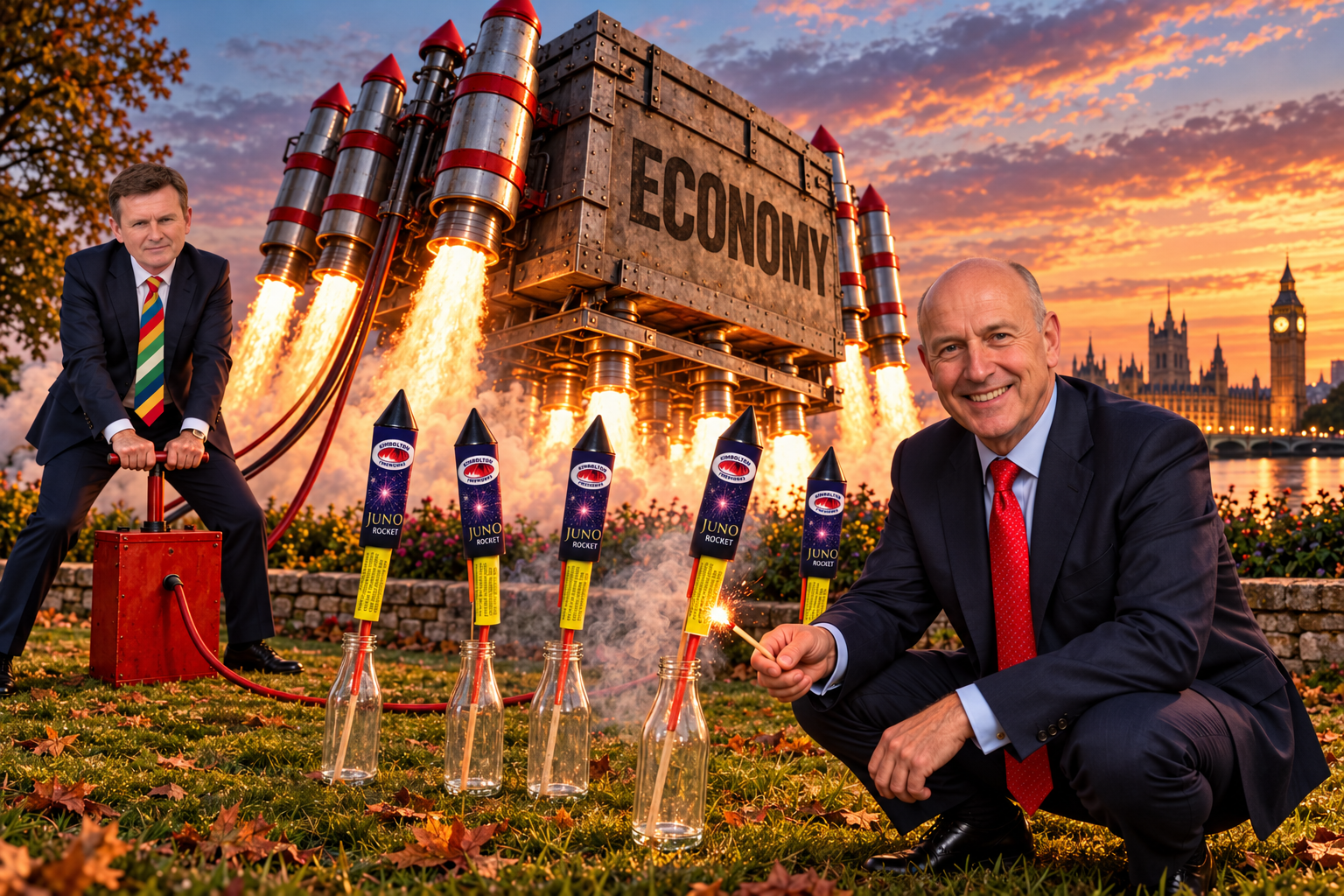
The economy needs rockets strapping to it, not a few fireworks. We need something much bolder. We need to Go For Growth.
This paper sets out what is getting in the way of growth, what other countries have done that works, what my plan is, and what benefit that will deliver.
This paper doesn’t stand alone. My Competencies in Schools paper https://joelhagan.com/post/a5039247-fbc3-483b-a0e0-22bb3bf3e9d4 and New National Service paper https://joelhagan.com/post/ff8de5df-125a-4d37-9ed5-b67b69e451db deal with the supply of more capable and prepared young people into the jobs market. Upcoming paper Welfare Isn’t Working will deal with the three million working-age adults outside the labour market. The Building Homes paper will deal with the cost to people of living near their place of work. The Big Decisions Framework paper https://joelhagan.com/post/cddc10d0-ab7a-4a8e-9d3f-c29e9adac5d8 addresses the problem of flip-flopping over infrastructure decisions.
What’s the problem?
At a high level, three things. What gets in the way of growth. Lack of incentives to grow. A failure to focus investment to drive growth.
Part one: what gets in the way
Twelve things, in four groups: attitude, permission, money, and people and mindset.
Attitude
1. Government doesn’t think business is the main event. Ministerial attention and taxpayer money go to the industries that look like the economy in a 1970s photograph. The companies that will be large in 2040 are treated as a good news story rather than as the policy. This is the attitude that produced Depledge’s resignation, and it sits underneath every other item on this list.
Permission
2. Planning stops things being built. Not only houses. Laboratories, factories, data centres, reservoirs, substations - critical national infrastructure required for growth. A system designed to adjudicate between neighbours is being used to decide whether the country gets a growing economy.
3. The grid cannot connect what we do build. Connection queues now run into the 2030s. A manufacturer who chooses Britain can be told the electricity arrives in eight years. We are turning away investment we have already won.
4. Energy costs too high. British industrial electricity is among the most expensive in the developed world. For anything that melts, forges, refines or computes, energy is a major cost component.
5. We prevent ourselves from using our own oil and gas. Jackdaw took too long. Rosebank remains unapproved. Meanwhile we import gas by tanker from fields with higher extraction emissions than our own. This is not an environmental policy. It is an accounting policy, in which the emissions move abroad and the jobs and tax go with them.
Money
6. Capital runs out at the scale-up stage. Britain starts companies well and grows them badly. Seed money is plentiful. At the point a company needs £20 million, the domestic market thins and the serious offers arrive from America with a condition attached about where the headquarters will be. Exits to foreign companies is a more attractive option than it should be. British pension funds hold some of the largest capital pools in Europe and put remarkably little of it into British companies.
7. The tax burden falls hardest before a business is profitable. Corporation tax is charged on success, so a loss-making company pays none of it. What an early-stage company does pay is employer’s National Insurance on every £ of pay, business rates on every square foot, and VAT collected quarterly. These come out of cash it does not have.
8. The administrative burden is a second tax. There are 5.7 million small and medium businesses, 99.9% of all private businesses, employing 60% of the private workforce. The Federation of Small Businesses puts the cost of tax compliance at £25 billion and 242 million hours a year, roughly £4,500 and forty-four hours for an average firm. For a business turning over £60,000, that is most of a month’s revenue spent working out what it owes.
People and mindset
9. Employment law has made hiring more risky. Every additional obligation attached to the act of employing someone raises the cost of being wrong about a hire. Large firms absorb it through an HR department. A five-person company absorbs it by not hiring a sixth.
10. Westminster believes it knows best. Decisions about what a place needs are taken by people who do not live there, through competitive bidding rounds that reward the quality of the bid rather than the quality of the project. If every part of the UK grew like the South East, the national figures would be transformed, and that cannot be unlocked from a desk in Whitehall.
11. There is flip-flopping about major infrastructure decisions. A third Heathrow runway has been government policy, then not, then policy again, for more than twenty years. HS2 was legislated, begun, and halved at a party conference. Every reversal writes off what was already spent and teaches investors that British commitments do not bind. Half a runway, half a jet fighter, half a bridge - worth nothing.
12. We are not building enough houses. People cannot move to where the work is because they cannot afford to live there. A labour market that cannot move is a labour market that cannot grow.
Part two: lack of incentives
13. We are not positioned competitively to achieve inward investment. Ireland has held the same corporation tax rate for twenty-three years and built a very successful economy on the predictability. We change ours, and the reliefs attached to it, almost every Budget.
14. We have made entrepreneurship less rewarding, repeatedly. Business Asset Disposal Relief has been cut three times, from 10% to 14% to 18%, and in this Budget the lifetime limit has been halved from £1 million to £500,000. The signal to anyone deciding where to build the next company could not be clearer, and it points away from here.
15. Visas keep out the people who would build things. Britain is now the most expensive developed country in which to hire an international expert, once the visa fee, the Immigration Skills Charge and the Immigration Health Surcharge are added together. A researcher bringing a family faces a five-figure bill before their first day. The Innovator Founder route that replaced the Start-up visa in 2023 barely functions, because the endorsing bodies withdrew.
16. We have cut ourselves off from the nearest labour market and trading partner. The Prime Minister said on 25 October that he would welcome an honest discussion about free movement, before the EU summit in Brussels on 20 November. The evidence on free movement, from the Migration Observatory at Oxford among others, is that European migration to the UK was fiscally positive: predominantly young, predominantly working, and substantially a revolving door rather than permanent settlement.
Part three: a lack of focus
17. Government money is spread too thin to do anything. The Modern Industrial Strategy names eight priority sectors covering roughly a third of the economy. That is not a choice, it is an inventory. Spreading the budget across everything we might be good at is likely to be no more than average in any of them.
What do other countries do
Estonia taxes profit when it leaves, not when it is earned. Since 2000, no corporate income tax on retained and reinvested profit; tax falls due on distribution. Estonia has the highest density of startups per head in the EU. The tax still arrives. It arrives when the money comes out.
Italy lets small firms file one simple return. Ironically for an otherwise overly bureaucratic county, the regime forfettario allows businesses below €85,000 to pay a single flat charge on turnover, with a coefficient for the sector’s typical profitability: 5% for the first five years, 15% after. No capital allowances, no accruals. France, Poland and Romania have variants of this.
Hungary shows the failure mode. Its KATA regime was so simple and so cheap that employers restructured staff as contractors to use it, and it was heavily restricted in 2022. Any simplified regime needs a disguised-employment test.
Ireland built an economy on not changing its mind. 12.5% on trading income since 2003, 25% on passive income so the country cannot be used as a letterbox, start-up relief capped and tied to the social insurance a company pays on real employees, 10% on income from intellectual property developed in Ireland, and a research credit that pays cash to companies with no profits. When the global minimum tax arrived, Ireland applied 15% to large groups and kept 12.5% for everyone else. The lesson is not the rate. It is twenty-three years of the same rate.
America makes founding personally worthwhile. Qualified Small Business Stock excludes capital gains on shares in a genuine small company, with the 2025 reforms raising the cap to $15 million and introducing partial exclusion from three years.
Israel and Taiwan chose. Israel’s Yozma matched foreign venture capital into Israeli startups and let the private investors buy the state out at cost plus interest. Taiwan built semiconductors out of a government research institute. Both backed new entrants. Britain’s economic failures of the 1970s including the Labour Government backing incumbents.
Germany grows outside its capital. Its states raise serious money, borrow within clear rules, and run their own economic development. Germany’s second cities are engines of growth.
What the Budget delivered
There were some good things. Most of which were in my own plan which was prepared before yesterday’s Budget.
To which one can add the following. The new 10% capital gains rate on lifetime gains up to £10 million for founders of the most successful firms. Data centres allowed to build on-site generation while they wait for a grid connection. Fiscal devolution, with 100% business rates retention by the end of the decade, 20% to Mayors from next year, a share of income tax from 2028, and £1.5 billion of devolved loans. Biodiversity requirements removed for more brownfield sites. The Small Business Rate Relief threshold raised from £12,000 to £18,000, taking 70,000 more businesses out of rates altogether. Jackdaw approved. A British Industrial Competitiveness Scheme taking 25% off electricity bills for 10,000 industrial firms.
And these, which ENTERPRISE BRITAIN welcomed https://www.enterprise-britain.com/news/our-verdict-on-the-budget : New ‘Founders Relief, Action on non-competes, Expansion of employee share options, Less unnecessary red tape - The Better Regulation Executive re-established, with £800 million of regulation and tariffs removed, More public sector procurement from start-ups and scale-ups, No CGT rise or exit tax.
But look at the shape of it. A lot of the Budget was no more than a handful of sparklers - a little something for everyone that will fizzle out soon enough and seem disappointing.
A market hall in Stafford, £10 million. An indoor market in Bury, £10 million. The Littlewoods Building in Liverpool, £20 million. A tech incubator in the Don Valley, £3 million. A science park in North Wales, £2.5 million. The Scottish Event Campus in Glasgow, £6 million. Aberavon Bridge, £11 million. AI and cyber in Belfast, £7.5 million.
Trouble is that there’s no underlying growth strategy. What appears to be driving the measures in the budget is the constituency map with money sprinkled on it.
There are some big gaps.
ENTERPRISE BRITAIN noted these as missed opportunities: Incentivising successful entrepreneurs to reinvest, Attracting global investors, and Boosting domestic investment from pension providers.
This is my list:
No change to what we tax. The Budget moved allowances about inside the existing system: the main first-year allowance up from 40% to 50%, the writing down allowance down from 14% to 12%. That shifts tax forwards and backwards. It does not change the fact that we tax companies on profit they earn rather than profit they take out.
No simplification for the smallest firms. Quite the reverse: self-assessment is being reformed from 2029 so that more taxpayers make smaller, more regular payments. More contact with the system, not less.
No help with the first hire. Nothing on employer National Insurance for small or new employers.
No VAT taper. The wall at £90,000 remains where it was.
Nothing on late payment. The single largest drain on small business working capital in the country, and it costs the Treasury nothing to fix.
Predictability went backwards. A 3% Bank Surcharge for fifteen months is the opposite of a tax regime a company can plan around.
Devolution arrived without guardrails. £1.5 billion of borrowing powers devolved and not a word about debt rules, oversight or capability.
No clear choices about what Britain will be great at. Eight priority sectors, too many, with money spread across all of them and a good many other things besides.
A Budget can only do so much in ninety minutes, and this one did some good. But big decisions were dodged - tackling the spiralling welfare bill, getting NEETS and others into employment, funding defence. There is no clear strategy for growth. It looks like fear drove the decision-making. A short-term fear of voters, a fear of the immediatereaction of capital markets. And yet ironically, the capital markets would have rewarded a bold plan for growth costed within our means; and voters will reward a plan that actually improves their living standards.
My solution
Six things. Designed to address the problems listed above. A clear cohered list. Unlike Reform’s 65 separate actions in no particular order with no explanation of their diagnosis of the problems https://www.express.co.uk/news/politics/2260230/nigel-farage-says-can-grow
1. Understand business better
The long-standing trouble with the Labour party is that it’s full of people from the public sector and local government. They just don’t understand business. But business is fundamental to the country. It generates the income that the public sector spends. It’s the sector that employs 80% of the population.
Put people who have built companies inside the Treasury and the Business Department, give them access rather than a title, and act on what they say. Depledge’s complaint was not that she lacked a role. It was that she had to win the same arguments twice.
A standing Council of Founders with a published agenda and published responses. Maybe don’t give them beer and sandwiches. An annual statement to Parliament on the cost of regulation to business, audited. And a simple test applied to every new rule: what does this cost a company with five employees?
2. Tax what leaves a business, not what passes through it
Corporation tax on distributed profits only, the Estonian rule. No tax on profit retained and reinvested. Tax due when profit is distributed.
This is a different system, not an adjustment to the one we have. The Budget raised the main first-year allowance from 40% to 50% and cut the writing down allowance from 14% to 12%, which moves tax forward and back inside the existing machinery without changing what is taxed. My proposal changes what is taxed: profit that leaves the company, rather than profit the company earns.
No cliff edge, because nothing changes at a threshold. No reason to close and reopen, because there is no clock to reset. No gain from splitting a company in two, because the trigger is distribution rather than size. And it targets itself: the fast-growing company reinvests and pays nothing, the lifestyle business paying dividends pays as now.
A Simple Business Tax for firms below £250,000. Opt-in, replacing corporation tax and employer National Insurance with a single charge on turnover with a sector coefficient, filed once a year on one form. No capital allowances, no accruals, no payroll computation. A business can work out what it owes without hiring anyone to tell it. With a disguised-employment test, so it does not become a device for converting staff into contractors.
A National Insurance holiday on the first five employees, capped. National Insurance is the tax a company pays before it is profitable, so it is the one that stops the first hire.
A VAT taper instead of a VAT wall. Liability phased in across a band above £90,000, so crossing the threshold does not cost 20% overnight.
Quarterly reporting voluntary under Making Tax Digital, not mandatory. The Budget moves the other way, reforming self-assessment from 2029 so that more taxpayers make smaller, more regular payments. That is more contact with the system, not less.
And statutory enforcement of payment terms with automatic interest. Late payment ties up more working capital in small British businesses than any tax takes from them, and fixing it costs the Treasury nothing.
On employment law, the targeted change rather than the wholesale repeal: restore a qualifying period for ordinary unfair dismissal, and exempt the smallest employers from the heaviest procedural obligations. Protection against discrimination and against dismissal for whistleblowing or pregnancy stays from day one, because that is not what makes hiring risky.
3. Unlock permission: planning, grid and energy
Planning as a growth policy, not a housing policy. Bring reservoirs, grid connections and strategic data centre and laboratory sites into the Nationally Significant Infrastructure regime. Make Development Consent Orders a genuine one-stop shop rather than a consent that then needs further consents. Limit repeat judicial review of decisions already taken by the Secretary of State.
Fix the connection queue so that projects ready to build go ahead of projects holding a place in line. And permit on-site dispatchable generation for industrial developments and data centres, so a project that can power itself does not have to wait eight years for permission to be powered.
Reform rather than abolish the environmental rules that do not work. Nutrient neutrality blocks tens of thousands of homes to solve a problem that agriculture causes. Biodiversity Net Gain should not apply to small sites in the same way it applies to large ones. The Aarhus cost rules make unmeritorious legal challenge close to free, which is why there is so much of it.
And use our own oil and gas while we still need them. Approve Rosebank. Restart licensing. Importing liquefied gas with higher extraction and transport emissions than domestic production, while telling ourselves we have reduced emissions, is an accounting trick that costs us the jobs and the tax as well as the gas.
4. Unlock capital and reward building
Pension reform, so that British savings can be invested in British growth: consolidation of the smallest schemes so they are large enough to hold illiquid assets at all, and a mandate to report domestic growth allocation.
A co-investment vehicle on the Yozma model, matching private capital into British scale-ups, with the private investors able to buy the state out at cost plus interest once the company succeeds.
A founder capital gains regime. The Budget has made a start here: Founder’s Relief gives a 10% rate on lifetime gains up to £10 million for the founders of the most successful firms. That is close to the Qualified Small Business Stock model and it is the right instinct.
But look at what was done alongside it. The Business Asset Disposal Relief lifetime limit was halved to £500,000 in the same statement. So the founder of an exceptional company is better off, and the owner of an ordinary successful one is worse off. That is a choice about which founders matter, and I do not think it is the right one. The person selling a profitable engineering firm in Dudley after twenty years is not a lesser contributor than the person selling a software company for £10 million.
And the piece that matters most is still missing. There is nothing here that rewards a founder who sells and starts again. A reinvestment relief, deferring tax entirely where proceeds go into another British company within three years, is the measure Brent Hoberman and others in the technology sector have pushed for years. They are right. A founder who sells and starts again is worth more to this country than a founder who sells and stops.
And Ireland’s discipline on inward investment: a headline rate fixed for the Parliament and intended for longer, a lower effective rate on intellectual property developed here, a research credit that pays cash to pre-profit companies, and a higher rate on passive income than on trading income.
The Budget did the opposite of this. It put 3% on the Bank Surcharge for fifteen months, starting in January and ending in March 2028. Whatever the merits of asking the banks to help fund support for energy bills, a tax that arrives and leaves inside two years is exactly the behaviour Ireland has avoided for twenty-three years. It is also the behaviour that teaches investors to discount what a British government says about the decade ahead.
5. Devolve the money, and remember the countryside
Retention of a defined share of locally generated tax. Multi-year settlements instead of competitive bidding rounds. Borrowing against future revenue for capital investment.
With guardrails, because Woking, Thurrock and Croydon all issued section 114 notices after speculative borrowing. Debt rules, independent oversight and a capability test, as the German states have. The answer to councils borrowing badly is to borrow properly.
This is now urgent rather than theoretical. The Budget has devolved £1.5 billion of loans to Mayoral Authorities, committed 100% business rates retention by the end of the decade, and promised a share of income tax from 2028. I support every one of those. Not one word was said about debt rules, oversight or capability. We are handing over the borrowing powers and leaving the safeguards for later, which is the order in which these things normally go wrong.
And this cannot only be about cities. Mayoral devolution has been built around metropolitan areas, which leaves rural and coastal England with the same centralised arrangements and worse connectivity. A county that cannot get a broadband connection or a bus service is not going to grow whatever the tax regime says. So what is being done won’t deliver “growth in every postcode”.
Infrastructure decisions need to stop moving. My Big Decisions Framework sets out how: a national commitment created by two thirds of the Commons and revocable only by the same majority. Applied immediately to the third runway at Heathrow. Whether London likes it is not the test. National economic benefit is the test, which is the Chancellor’s position and the right one.
6. Focus
Not eight industries. Three, with the money, the regulatory attention and a visa system supporting them.
Artificial intelligence and the compute to run it. We have the research base, the language, two of the most significant AI companies in the world founded here, and the designs in nearly every phone on earth. What we lack is power and permission, both of which are on this list already.
Life sciences and genomics. Oxford, Cambridge, two of the world’s largest pharmaceutical companies, and in UK Biobank a research asset that genuinely does not exist anywhere else. This is the clearest comparative advantage Britain has.
Advanced engineering for defence and space. Rolls-Royce, BAE, small modular reactors, satellite manufacturing in Surrey and Glasgow, and a launch site in Shetland. It is also the one sector with guaranteed rising domestic demand, because defence spending is going up here and around the world whoever wins the next election.
Three areas. Everything else competes on the general conditions, which this paper has spent the previous five sections improving. That is the point: fix the base, then concentrate the discretionary money where we can actually take a global lead.
The market made the same three choices on Budget day. Rolls-Royce committing £2.5 billion to next-generation turbine technology. More than £1 billion of life sciences investment from Kindeva, Vertex and Convatec. A Sovereign AI Unit for strategic British AI firms. Advanced engineering, life sciences, artificial intelligence. When private capital and government money land in the same three places on the same afternoon, that is not a coincidence. It is a strategy.
And on visas, cut the upfront cost for roles in those three sectors, and replace the Innovator Founder route with something a founder can use. We should not be charging a research scientist five figures for the privilege of bringing their family to work here.
And Europe
The OBR’s standing estimate of the long-run productivity cost of our current trading arrangements is around 4%. That is larger than everything else in this paper put together.
I have set out elsewhere https://joelhagan.com/post/cddc10d0-ab7a-4a8e-9d3f-c29e9adac5d8 how big decisions should be taken. Not on a narrow majority, and not twice in a decade. But the intermediate steps need no treaty and no referendum. A youth mobility scheme, which the EU has proposed repeatedly and Britain has refused. Mutual recognition of professional qualifications. A veterinary and food standards agreement. Erasmus. Visa-free touring for musicians.
Those are available now, and they are worth having whatever we eventually decide about the larger question.
What’s the cost, what’s the benefit
The Estonian rule is largely a timing change. The tax still arrives, on distribution. There is a transitional cost while the system changes over and a permanent cost to the extent that profit is reinvested and never distributed, which is the behaviour we are trying to produce. It needs proper costing and it is nothing like the cost of an equivalent rate cut.
The Simple Business Tax is close to neutral and may raise money. Firms below £250,000 contribute a small fraction of corporation tax receipts, which are concentrated in around 7,000 large companies paying more than 60% of the total. Against that, simplicity recovers revenue currently lost to error, which HMRC’s own analysis attributes disproportionately to small businesses defeated by complexity rather than to deliberate avoidance.
The National Insurance holiday and the VAT taper are real costs, in the low billions, partly recovered through income tax and employee National Insurance on the jobs they create.
Planning reform, grid reform, payment enforcement, pension reform, the co-investment vehicle and the visa changes cost the Treasury almost nothing, and several of them are the largest items here by economic effect. The most expensive things we do to our economy are mostly free to stop doing.
Choosing three sectors costs nothing extra, because the money is already being spent. But its effect is being diluted by being spent across eight.
The tax measures cost money in the early years and need to be funded. The structural measures cost almost nothing. The return comes from a wider tax base rather than a cleverer tax: more companies surviving past year five, more of them scaling here rather than selling to the US.
Summary
Britain is not short of ambition. It is short of permission, patience and capital.
Treat business as the main event, not a good news story at the margin.
Tax what leaves a business, not what passes through it. No corporation tax on reinvested profit. One simple tax for the smallest firms. No National Insurance on the first five hires. A taper instead of a wall at £90,000. And make people pay their bills on time.
Give permission. Build, connect to the grid, use our own gas, and stop changing our minds about runways.
Unlock the capital, which exists, and is going elsewhere.
Devolve the money, with rules, and do not forget the parts of the country that do not have a mayor.
Choose three sectors and back them. AI and compute. Life sciences and genomics. Advanced engineering for defence and space.
Have an honest conversation about Europe, because it is worth more than everything else here, and the first steps need nobody’s permission but our own.
𝚃𝚑𝚎 𝙾𝚗𝚎 𝙼𝚊𝚗 𝚃𝚑𝚒𝚗𝚔 𝚃𝚊𝚗𝚔