Introduction
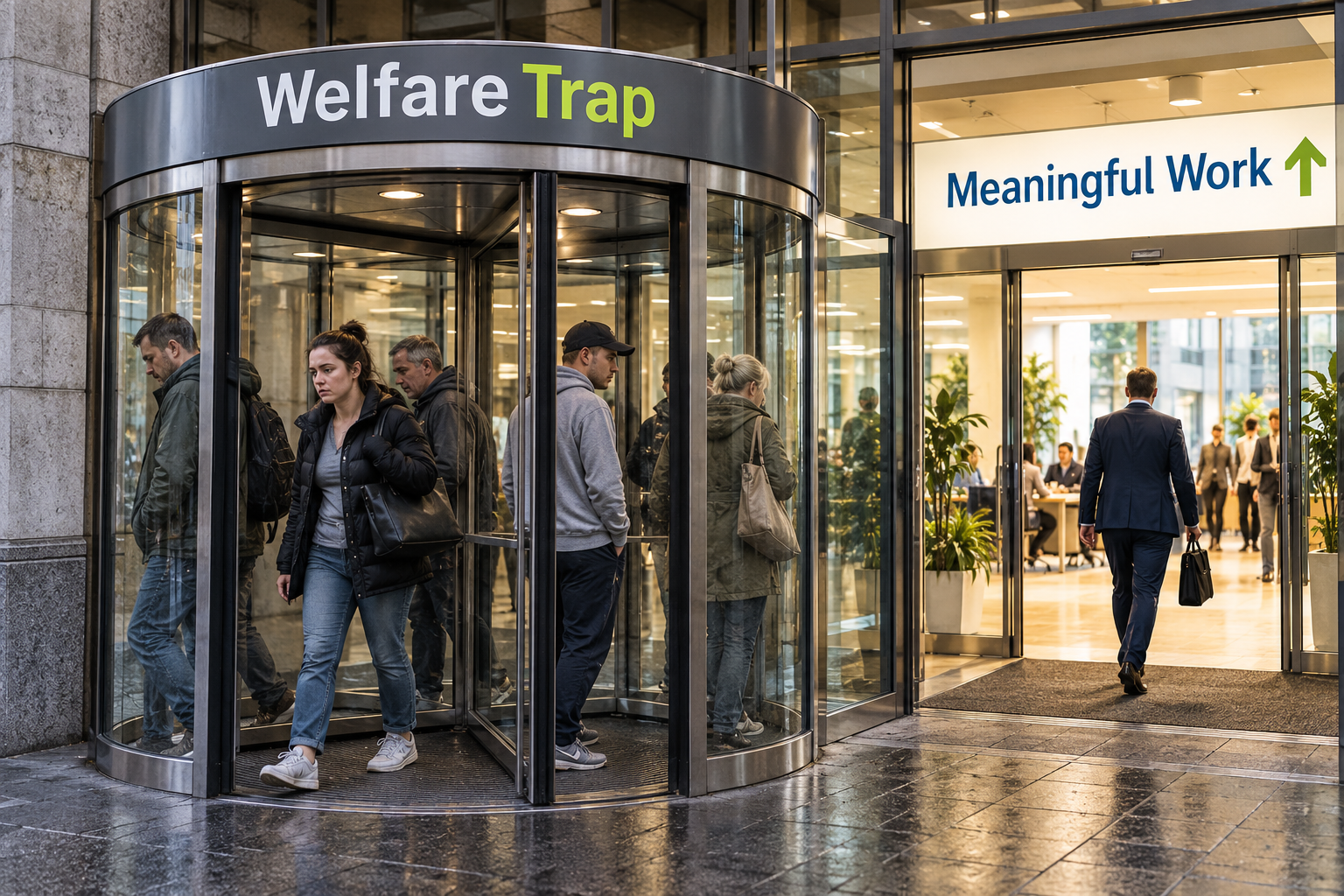
Welfare costs too much. That cost is rising. And the money we spend isn’t working: it isn’t getting people into work, especially young people. Not helped by an economic/growth policy that isn’t delivering a high enough level of growth fast enough (see my paper Go For Growth for the solution to that https://joelhagan.com/post/ef75aa0a-1162-4813-af8c-1bf4d5baf2f7).
Welfare has been the largest single Government expenditure for 45 years. Off its peak of more than 12% of GDP in 2010/11, not back at the COVID peak of just under 12%, but back on the increase with quite a steep gradient. That’s set to continue unless something changes and we’ll be back at 12% before we know it.
We spend more on Welfare than on Health and Defence together. Andy Burnham is simply wrong to have said at PMQs: “We do everything to support our national security, but it can’t come at the expense of social security.” In a final choice, defence of the nation is more important than benefits. He presented the opposition with an easy goal.
Just more than half of Welfare spending is Pensions, and in my view the Double Lock doesn’t go far enough to curb increases in that cost. That’s tough for the Tories and the Liberal Democrats whose support is disproportionately high amongst the elderly compared with the nation as a whole. So they opposed any change to the Triple Lock along with Reform.
Meanwhile, it’s unpalatable to the Left simply to say that we should cut Welfare spending by cutting benefits. Labour’s support is disproportionately high amongst the young and idealistic, and those on benefits.
In any case just cutting benefits is a simplistic approach when what we spend isn’t delivering the outcome we desire. So any solution will need to concentrate on delivering a better outcome, thereby delivering reductions, not just a reduction in cost.
The Government has set out its stall on Pensions: a Double Lock from 2030. In the next Parliament.
It says it’s on the job with Welfare spending, but it delivered nothing in the Budget after 100 days in which to consider, formulate a position and get the party behind it. Then they messed up the comms immediately after the budget under pressure from all quarters.
Alan Milburn is also on the job. His report on young people and work is due in November. The Government will give its official initial response to the report’s recommendations by the end of this year; there will then be a White Paper in the first half of 2027; and then the introduction of actual welfare legislation to Parliament in the second half of 2027.
The approach leaves the Government open to the criticism that they’re kicking the can down the road. Even if one was being generous and realistic about how long it takes to build consensus in a controversial area, this is hardly the “sweeping,”radical” economic and political overhaul aimed at “tearing up the last 40 years of political consensus” and ending neoliberalism in Britain” that Andy Burnham promised.
The Problem
Welfare is costing the country too much, that cost is ever increasing, and we simply can’t afford it. Just like the Pension Triple Lock.
Welfare has been the largest single block of Government spending for decades, running between 9% and 12% of GDP since 1980. It spiked after the financial crisis, spiked again during the pandemic, and has never returned even to where it started before those spikes. Indeed it’s increasing.
Health is just under 8%. Defence spending has fallen from around 5% of GDP in 1980 (as much as we spent on schools) and is now around 2%.
A not unreasonable defence of that, which I haven’t heard the Tories use because they’re so scared of not saying sorry for what they are believed to have done wrong, is that those were safer times - everyone of a certain age would recognise that - and it seemed like a cost that could be cut. Indeed the so-called Peace Dividend resulted in the whole of NATO cutting Defence spending from an average of 3.8% of GDP in 1980 (when the UK was spending 5%) to 1.4% in 2015 (UK 2%). While the UK’s expenditure then went to 2.3% by 2025, NATO’s average caught us up at 2.3% from their 1.4% 2015 lowpoint; they got motoring when we didn’t. And in retrospect both the UK’s expenditure and the NATO average look to have been too low because they have left Europe under-defended and, alongside a weak response to the seizing of Crimea, have enabled Putin to pursue his expansionist agenda, most recently and most dramatically into Ukraine.
The UK Government has now committed to getting Defence spending up to 3.5% by 2035. Still nowhere near enough to catch up and become truly robust again.
But back to Welfare. The Economist spelled it out: one of the great fantasies of British politics is that the country can sustain a welfare state similar to today’s without raising taxes.
This is the breakdown of the approx £330bn of spending on Welfare according to the OBR’s March 2026 forecast:
2025-26
2030-31 forecast
Pensioner benefits (of which State Pension £146.1bn)
£177.7bn
£180.7bn State Pension alone
Working age and children
£145.0bn
of which health and disability benefits
£77.1bn
£109.8bn
of which housing benefit and UC housing element
£37.3bn
£25bn to £30bn
Pensioner benefits are 53% of the total and working age and children 43%, with the balance in smaller items. Within the working age bracket, health and disability benefits are the largest single element - 23% of all welfare spending, and more than half of everything spent on people of working age.
The key driver of growth in cost is health and disability benefits. PIP rises from £21.7 billion in 2025-26 to a forecast £44.7 billion by 2030-31. Incapacity benefits including the UC health element are forecast to exceed £91 billion by 2029-30.
Disability benefit recipients were 6.5 million in 2024-25 and are forecast to reach 8.8 million by 2030-31. Incapacity recipients were 3.4 million, heading for 4 million. PIP claimants in England and Wales passed 4 million in April 2026.
Of working-age people receiving PIP or DLA in March 2026, 65% also received either health-related Universal Credit or an incapacity benefit. These are not two separate populations.
Housing benefit and the UC housing element cost £37.3 billion. That is not a welfare problem, it is a housing problem showing up in the welfare budget, and it will not be solved by anything in this paper. It will be solved by building houses, which is the subject of a future paper.
The costs have been going up for 5 reasons. In descending order of their impact they are:
The design of Universal Credit. The gap between the standard allowance and the health element is around £400 a month. That is a powerful financial incentive to be assessed as unfit for work, and the Work Capability Assessment is a single binary gate with a large prize behind it. We have built a system that encourages people to describe themselves as incapable of work.
Mental health and neurodiversity claims. This is the fastest-growing category of new PIP awards, and it’s particularly prevalent among younger adults. The question is: whether the system is responding to genuine need that went unrecognised before, or to changed diagnostic thresholds and an extra condition that it is easy to assert and difficult to disprove, or both.
NHS waiting lists. People waiting for treatment cannot work, and claim health benefits while they wait. Part of the Welfare bill is an NHS capacity problem.
An aging working-age population. More people in their fifties and sixties, the decade when health problems multiply, are inside the working-age benefit system.
Assessment capacity and process. Reassessments were suspended during the pandemic and have never fully caught up. The stock of claimants includes people whose circumstances were last tested years ago.
As a bit of an aside, I will relate my own limited experience. I was really very unwell 18 months ago, but had great and repeated difficulty obtaining, in a timely fashion, a fitness for work statement that matched my own assessment of what I was able to do. Aside from the excessive administrative time to produce anything (typically a month or more), I found consultants unwilling to commit without consulting - in my view hiding behind - others even when they were the lead in relation to my case and condition. I found my employer slow and reluctant to accept my assessment without separate occupational health assessments, and the Fitness to Work Statement.
It cost me income. It cost the country tax. And it was unfulfilling not to be working as much as I was able to.
That’s just me. But I tell the story because it illustrates a key difficulty: the system isn’t set up to get people back into work - to income, tax-paying, socialisation, self-respect, better mental health, etc. - it’s almost the opposite. It’s easiest to leave people off work as the default.
Finally we should remember that young people being out of work is a temporary problem, even if it feels urgent. It is driven by the impact of AI, a slow-growing economy, adverse changes for employers in terms of increased input costs, increases in minimum wage, increased taxes, and a weak economy. Neither the fault of the young people, nor of the welfare system.
If a specific response is required for the 1 million young people out of work then develop it as a programme, not as a permanent feature of the system. The solution to that part of the Welfare bill is in large part eroding the minimum wage for younger people for the time being, reducing the tax burden on business, getting energy costs for business down, and putting a rocket under economic growth. Along with implementing the changes proposed in my Competencies in Schools https://joelhagan.com/post/a5039247-fbc3-483b-a0e0-22bb3bf3e9d4 and New National Service https://joelhagan.com/post/ff8de5df-125a-4d37-9ed5-b67b69e451db papers.
We don’t want another Pension Triple lock that is subsequently difficult to get out of.
Learning from history
Beveridge, 1942. The founding settlement: contributory insurance against interruption of earnings. The contributory principle has been eroded ever since, to the point where most working-age benefits are now means-tested rather than earned. “Something for something” is the oldest idea in British welfare, not a new one.
Fowler reviews, 1985-88. Income Support, Family Credit and Housing Benefit restructured. Succeeded administratively, but did not change the cost trajectory.
New Deal, 1998. Job search support with a work requirement for young people. The evaluations were reasonably positive on employment effects, but the programme was expensive per outcome.
Freud report, 2007, and Universal Credit, 2010 onwards. The big one: merge six benefits, make work always pay through a single taper. Right in principle. The rollout took thirteen years, cost far more than planned, and the taper rate ended up higher than the design intended, so the promise that work always pays was never fully delivered.
The Work Capability Assessment, 2008 onwards. Outsourced to Atos, then Maximus. Repeated findings of poor decision quality, very high appeal success rates, and real distress. The assessment is the single most discredited instrument in the system, and every subsequent attempt at reform is too easily described as an attack on disabled people and thwarted however sensible it might be.
The 2025 attempt. The Universal Credit and Personal Independence Payment Bill proposed a four-point rule for PIP eligibility, intended to save about £5 billion a year by 2030. 126 Labour MPs signed a rebel amendment. The Government made concessions, limiting changes to new claimants from November 2026. That was not enough: 90 minutes before the vote, the Government folded and PIP eligibility changes were dropped altogether, pending a review by Stephen Timms. The Bill passed 335 to 260 with 49 Labour MPs voting against. The concessions removed most of the savings. It was an abject and evident failure of the Starmer regime. With repercussions for Starmer’s ability to get anything controversial through.
I can’t help but think of Blair and how effective he was at holding a radical line and getting his party to back it. Starting with the re-writing of Clause 4, through independence of the Bank of England, devolution for Scotland and Wales, National Minimum Wage, and PFI. The contrast with the weak-kneed Keir Starmer couldn’t be greater.
The 2025 reform failed not because the diagnosis was wrong for leadership and presentational reasons. It was proposed as a cut with a savings target attached which changed entitlement before anybody had fixed the assessment that determines entitlement, and Starmer buckled under pressure.
Learning from other countries
In the 1990s the Dutch had the highest disability benefit rate in Europe, around 12% of the workforce. A series of reforms through the 2000s cut it dramatically. The central mechanism, the Gatekeeper Protocol of 2002, is widely assessed as the most effective single change.
It works by making the employer the gatekeeper rather than the state. An employer must keep a sick worker’s job open for two years, pay at least 70% of salary throughout, produce a reintegration plan within six weeks, adapt the workplace, fund treatment where it helps, and look for alternative work inside or outside the firm. The state assesses for disability benefit only after two years, and only if the employer can show it did all of this. If it cannot, the employer pays a third year.
The result: disability benefit inflow fell from 0.71% to 0.52% of the insured population within a year of introduction. The 2006 reform reduced benefit receipt by a further 5.2 percentage points and raised labour participation.
This wasn’t a cut. Nobody’s entitlement was reduced at the point of need. It changed who is responsible for preventing the claim in the first place, and it did so by putting the cost on the party best placed to act.
Denmark runs the most intensive activation system in Europe. Mandatory meetings from the first weeks of a claim, an individual action plan, and a caseworker who stays with the person rather than passing them between offices. It is paired with generous benefits and weak employment protection. High employment, high spending, high taxes. The lesson usually drawn is that generosity and activation are complements rather than opposites.
Germany’s Hartz reforms, 2003-05, merged unemployment assistance and social assistance, cut duration, and tightened conditionality. Unemployment fell substantially. They are also the most politically toxic reforms in modern German history, blamed for in-work poverty, partly reversed by the Bürgergeld in 2023 and then tightened again.
Switzerland and Sweden both achieved marked falls in disability claims through early intervention and rehabilitation requirements rather than eligibility cuts.
Australia operates mutual obligation with a points-based activity system and private employment services. Decisive, heavily sanctioned, and repeatedly criticised for poor-quality placements.
So, we can conclude that the following work:
Job search assistance has the best short-run return of any active labour market policy. Cheap, fast, and effective for people close to the labour market.
Training works, but slowly. Evaluations typically show negative effects in year one, because people are not job-searching, and positive effects from year two or three.
The consistent finding across OECD countries is that sanctions get people off benefits faster, into lower-paid and less stable work, with measurable hardship for those sanctioned.
Individual Placement and Support works best, especially for the UK’s fastest growing cost driver. Place people in real jobs first, then provide clinical and employment support in parallel. Randomised trials for people with severe mental illness consistently show employment rates roughly double those of train-then-place programmes.
Early intervention beats late assessment. Every system that has reduced disability claims has done it by acting in the first weeks of sickness absence, not by reassessing people years later.
My solution
Seven principles:
Principle 1: Change has to be presented and intended to be an increase in the number of people in work. Savings are an outcome, not the main driver.
Principle 2: Prevention beats assessment. The cheapest claim is the one that never starts.
Principle 3: Nobody is written off. Everyone is reassessed on a cycle, at most every 5 years, with the frequency set by condition rather than by administrative convenience. A permanent award should require a reason that is genuinely permanent.
Principle 4: Work must always pay with no cliff edges. This has to be clear to all: potential claimants, claimants, and the society that pays the benefits bill.
Principle 5: Support is conditional on effort. Reciprocity, with sanctions as the backstop rather than the instrument.
Principle 6: Concentrate on ability to work, not disability, and be timely about it. The question is what someone can do and how much of it, not what they cannot do.
Principle 7: People who genuinely cannot work will be provided with a secure and adequate income.
Ensuring it’s aligned with those principles, my solution consists of 4 changes:
Change 1: A Single Lock Pension
The Triple Lock has done its job. Pensioner poverty is now 14% against 20% for the population as a whole. The pension has risen 81% since 2010 while prices rose 56% and working-age benefits 41%. Pension spending is by far the largest component of the Welfare bill, and the ratchet that produced it has no end-point.
The Single Lock will be CPI. It will ensure that Pensioners’ standard of living does not reduce.
CPI measures the actual change in the cost of everyday goods and services: food, energy, clothing, the things a household actually buys. A pension that rises with CPI buys the same basket this year as it did last year.
It matters most to the people with the least. A low-income retiree spends a far higher proportion of their income on essentials than a wealthy one. Without a CPI link, a sudden inflation spike of the kind we have lived through recently does not merely reduce comfort, it rapidly erodes the ability to afford basic necessities and pushes people into poverty.
Removing the Earnings Lock means that pensioners don’t automatically benefit from rising national affluence. Governments should review pensions every three to five years and check whether earnings growth has not left pensioners materially behind, and decide whether to do something about it. That is a decision for a Government to make because there will be choices about how to spend increased tax take. If the country can afford in future to cut pensioners into that benefit then it can choose that over other ways of deploying the money. Such decisions are exactly what governments are in place to make.
The Government has announced that from 2030 there will be a Double Lock: earnings and inflation. A step in the right direction, but it doesn’t go far enough. And it’s a missed opportunity to get the Welfare bill under control without being unfair to anyone.
Change 2: Employers as the gatekeeper
We should adopt the Dutch model, adapted to UK employment law. When an employee becomes long-term unwell, the employer keeps the job open, continues to pay a defined proportion of salary (relatively high) for a defined period (relatively long), produces a return-to-work plan within six weeks, adapts the role or finds another one or finds one outside the organisation that is more suitable, and demonstrates what it has tried. The state assesses for health-related benefit only after that process has run.
Employers are the party best placed to play this role, because they know the individual, have the job, the information and the relationship.
Requiring employers to pay a relatively high salary for a relatively long time creates the incentive to deliver people back into work as quickly as they can cope with. Currently employers have every incentive to let somebody drift onto the state’s books, and no obligation not to let this happen.
This system will ensure by design that people get back into work, benefits are reduced, and tax-take maximised.
There will be transitional support for small employers, because a firm of five cannot carry what a firm of five thousand can.
Change 3: Change how assessments are made
Determine fitness for work with medical and occupational health input, stating what types of work a person could do and how much of it, rather than issuing a binary verdict on whether they are capable of anything at all.
Reintroduce in-person interviews with verified identity, at a frequency appropriate to the condition and at most every five years. It is harder to dissemble face to face, and it is also harder for an assessor to miss what somebody can do.
Commission a balanced review of mental health and work, examining the evidence on where work supports recovery and where it genuinely prevents it, and redraw the lines accordingly. Stop treating mental health in the same way as physical health - they’re different.
An assessment that finds someone genuinely unable to work results in a settled award, reviewed rarely, with no requirement to keep proving it.
Use data to flag cases for review but not to decide them. How many times have we heard of people on disability benefit out dancing or playing sport or cavorting on holiday abroad? This is a PR disaster for Government. So, monitor social media and flag up possible system abuse and follow it up. Never let reassessments become overdue.
Ensure there is an appeal process, but that an overturn is the exception rather than the rule. If overturns are commonplace, there’s something wrong with the way assessments are done.
Change 4: Get people into meaningful work where they’ll stay
Adopt the Danish activation model. Early, intensive, compulsory contact from the first weeks of a claim. An individual action plan. One caseworker who stays with the person. The UK spends around 0.2% of GDP on active labour market policy. Denmark spends nearer 2%. I’m not proposing that we achieve that level, but the current level buys almost nothing so it’s no wonder we’re not getting back back into work on an enduring basis.
Adopt Individual Placement and Support for the mental health caseload, at scale. Place first, then support. It is the single best-evidenced intervention in this field and it is currently available to a fraction of the people who would benefit.
Test everything and drop what fails. Assistance back into work has to be neither so expensive that it cannot be justified nor so weak that it does nothing. Methods should be trialled, measured, and jettisoned quickly when they do not work.
Ensure that work pays and there are no cliff edges. There must be no point in the system at which working more leaves somebody worse off.
Restore the two-child cap for child support. This is about what it is right for the state to support, not about punishing children. The state should not underwrite decisions to have children that the family cannot afford or provide a level of support that discourages working.
The savings
These are the savings, costs and net savings of my plan against the system as it is today.
Annual effect by the mid-2030s
Pension: a single CPI lock in place of the triple lock
£10bn
Prevention: the employer gatekeeper
£10bn
Reassessment on a five-year cycle
£4bn
Two-child cap restored
£3.5bn
Activation: benefits no longer paid to people now in work
£2.5bn
Gross saving
£30bn
Activation programmes: Danish case management and IPS
−£3.5bn
Assessment capacity: in-person, medical input, five-year cycle
−£1.5bn
Transitional support for small employers
−£1bn
Net saving
£24bn
Income tax and National Insurance from additional employment
£1.5bn
Total fiscal benefit
£25.5bn a year
That is more than the entire cost of a National Care Service. And it is achieved without reducing a single payment to a single person who genuinely cannot work.
The Budget
Some of what I am proposing is now included in Government plans.
Face-to-face assessments are being reinstated. Universal Credit is being rebalanced so that it does not force people to label themselves as too sick to work, which is the design flaw identified above. Motability is being reformed. The triple lock becomes earnings and inflation from 2030. Milburn and Timms report next month. It is rumoured that John Healey will break a manifesto promise and retard the increase in the young person’s minimum wage which was supposed to catch up with all ages.
Aside from the abject failure to put rockets under economic growth, the Government has got the Welfare diagnosis half-right. The half it has missed is what prevents the claim starting in the first place. Nor does their plan deliver enough on the huge pensions bill, the biggest component of Welfare spending. And there is no cap on the number of children for child benefit, which can prevent work from paying.
Summary
Welfare is the largest single thing this country spends money on, it has been for forty-five years, the cost is rising, and it is not delivering what we need from it.
Four things will fix that:
A Single Lock pension. CPI, so that pensioners’ standard of living is protected, with a review every few years to decide whether to cut pensioners into greater societal affluence if that is ever the case.
Employers as the gatekeeper. Make employers the gatekeeper because the cheapest claim is the one that never starts.
Change how assessments are made. Ability to work rather than disability. Medical and occupational input. In-person assessment. Repeat on a frequency according to condition. An honest look at mental health and work.
Get people into meaningful work where they’ll stay. Individual Placement and Support at scale, work pays without any cliff edges, the two-child cap restored.
This will deliver a reduction in cost of around £25 billion a year by the mid-2030s. Enough to fund a National Care Service, take the strain off Defence, reduce taxes or the deficit. My Health and Wellness Levy is a better way of funding Care, so I would spend this elsewhere - on Defence first then on tax reductions.
These changes are the best way of getting Welfare to work i.e. getting people back into work as quickly and as fully as possible. It is not driven by cost-cutting as a primary objective. This is what matters to most people. Even if the changes do deliver a very significant reduction in cost.
We need people in work for their income and the tax take that comes with that, for their self-respect, for their mental health. We need adequate support for people who genuinely cannot work without stigma or humiliation. My solution delivers all of those.
𝚃𝚑𝚎 𝙾𝚗𝚎 𝙼𝚊𝚗 𝚃𝚑𝚒𝚗𝚔 𝚃𝚊𝚗𝚔