Introduction
People say there’s a housing crisis, and that is generally accepted. I don’t think most people appreciate exactly how big the problem is.
There are 30.4 million homes in the UK; we need 6.5 million or 21% more. On top of the 200,000 homes a year we need for underlying growth in demand.
The problem is in part not having enough homes, but we should remember that what it represents is people not being able to get off the streets, move for work or to fulfil their personal aspirations whether that’s home ownership, a larger home to meet the needs of a growing family, or a smaller home when circumstances have changed.
It’s a people thing, not just a numbers thing.
Spreading the shortfall over 15 years means an average of 433,333 new homes a year are required. Last year we built 196,900 - less than half what’s needed. Completions, as opposed to net additions, were 143,110 in 2025-26, the lowest figure since 2015-16. Add in the 200,000 to tread water, and that’s 633,333 new homes a year required.
The Labour Government’s commitment is to build 1.5 million new homes over the course of five years, an average of 300,000 homes per year. They’re well below that already and in any case it isn’t nearly ambitious enough to solve the problem the UK has - the Labour target is less than half what’s needed and they can’t even hit their target.
The amount of building currently demonstrates that there are significant barriers and a lack of incentives and focus to deliver at the required scale.
There are examples overseas that we can draw learnings from. How did building permits per head in Auckland double within five years?
My solution addresses the barriers and incentives, and incorporates the learnings. It has four components:
Help people onto the housing ladder
Uncork the bottle, so that existing homes change hands
Make buying a quicker and more certain process
Build, baby, build
This will ensure that we deliver at the required level and solve the problem. After 15 years, we can revert to a programme that is responsive to projected population growth at that time so we never get into the same mess again.
The problem
Sizing the problem
There are about 30.4 million homes in the UK, housing 68.2 million people. That is 446 homes per 1,000 people. The European average is 542. France has 560, Germany 516. We’re the second worst in Europe.
To reach the European average we would need 6.5 million more homes. That is the Centre for Policy Studies figure, and it is an increase of 21% on everything we have today. For every 5 homes, that’s 1 more.
Other estimates are lower because they measure something different. The National Housing Federation and Crisis put the shortfall at around 4 million by counting households in need rather than comparing us with our neighbours.
As Jimmy Carr puts it: “How happy you are is the quality of your life minus envy.” We should be comparing ourselves with our neighbours.
Closing a 6.5 million gap over fifteen years requires 433,333 homes a year. But that is on top of the roughly 200,000 homes a year - for every 10 homes, 1 more - needed simply to house the new households forming each year. New households form whether or not we close the backlog.
So the real number is 633,333 homes a year. Around 200,000 to stand still, and 433,333 to catch up. For every 10 houses, we need 3 more.
Last year we built 196,900. Pathetic.
We are building enough to stand still, and nothing at all to close the gap. That is why the gap hasn’t closed in fifty years.
The Government’s target is 1.5 million homes in this Parliament. Between the opening of Parliament in July 2024 and 20 September 2026, 437,900 were delivered. That is 29% of the target with 44% of the time gone. Savills forecasts an average of 167,500 a year to 2029-30, which would miss the target by 662,500 homes. To catch up from here the industry would need to build around 361,000 a year, which is more than it has ever done in modern times.
So the Government will miss a target that was itself too small to solve the problem.
Locating the problem
The crisis is not evenly spread, and it takes two different forms.
Absolute deficit, where there are simply not enough homes. Liverpool has the biggest deficit in the UK, short an estimated 232,759 homes. Leicester is second, short 135,201.
Affordability, where homes exist but nobody who works locally can buy one. Kensington and Chelsea runs at nearly 17 times earnings. Oxford at 10. Hertsmere at 10. In the Lake District 27% of homes are second homes or holiday lets, and prices run at 12 times local income.
And London manages both at once: a raw surplus of built units alongside a structural gap of 1.1 million entry-level and social homes, with 40.8% of households in overcrowded, substandard or severely cost-burdened accommodation.
And the queue behind all of it: 1.29 million households on social housing waiting lists, projected to reach two million within a decade. Meanwhile 41% of the homes sold under Right to Buy are now privately rented, which costs the taxpayer an estimated £1.5bn a year in housing benefit on homes the state used to own.
Rural England has its own take on the problem. House prices at 8.8 times earnings, social housing at 9% of stock against 19% in urban areas, and waiting lists that on current turnover would take 89 years to clear.
How did we get here?
We stopped building council houses, sold them off and never replaced them.
In the late 1970s around 30% of households in England lived in council housing. By 2023 it was 6%.
Right to Buy was introduced by the Housing Act 1980, with Michael Heseltine as the Secretary of State responsible. Since then 1.9 million council homes have been sold in England, 2.4 million across the UK, at an average discount of 44%. That is about 40% of the entire council housing stock. The receipts came to more than £51 billion. Those same homes are worth around £430 billion today.
The policy itself was popular and, in its own terms, successful. It created a million and a half new homeowners. The failure was not the selling. It was that the homes were never replaced.
Michael Heseltine was the Environment Secretary who took the Housing Act 1980 through, making the right to buy a reality. He has subsequently acknowledged that too little of the money raised was put back into social housing after he left the department in 1983, placing the blame on a Treasury that preferred to snaffle it. He remains a strong supporter of the policy.
Councils were restricted in how they could use the receipts. Replacement never came close to one for one. 41% of the homes sold are now owned by private landlords, which means the state is frequently renting back, through housing benefit, the homes it sold at a discount.
And it continues. 14,275 council homes were sold under Right to Buy in England in 2025-26, against 2,850 new council homes completed. Shelter’s estimate is that only 4% of everything ever sold has been replaced.
We created systems that prevent or discourage people from moving.
Getting people off the streets hasn’t been a priority for many councils.
Financing a first move is tough to impossible for first-time buyers.
Stamp Duty is a hindrance to rightsizing when people get old or get divorced. It’s often described as one of the most hated and economically damaging taxes in the UK, if not the most. It’s a disincentive to move. It acts as a massive upfront penalty on moving home, costing buyers huge amounts of money. It traps homeowners: those looking to downsize cite Stamp Duty as a key barrier for them; that locks up larger family homes and freezes the ladder: it blocks the property chain by discouraging one move, which ripples out and stops multiple other buyers and sellers from completing transactions. It is economically inefficient: economists and organisations like the Institute for Fiscal Studies and think tanks frequently point out that transaction taxes create severe “deadweight loss” by shrinking the volume of housing market activity. No wonder people want it to be abolished.
Inheritance Tax creates an incentive to hang on to a property rather than sell it and set off a chain of transactions.
The soon-to-be-introduced removal of the Right to Buy for new-build social homes stops what was an increasing number of people from moving forward in an existing property, improving their life chances.
This isn’t about how we got here so much as where we’re about to go.
I know what the Government is thinking: removing the right to buy puts a cork in the bottle of council/social home numbers while they focus on building more of them. It turns a projected net loss of 26,000 council homes over the next decade into a net gain of 18,000.
But it’s a cork nonetheless and we should be uncorking. We shouldn’t be denying 2.4 million households the thing that everybody else in the country is encouraged to do.
Right to Buy sales in England rose 90% in 2025-26, to 14,275, and passed two million cumulatively. Some of that was a rush to beat the reduction in discounts. Thousands of households moved quickly, at their own expense and on their own initiative, to take an opportunity they could see was closing.
That illustrates the demand. In a year when buying anything was harder than it has been in two decades, the number of council tenants buying their home nearly doubled. The short supply of affordable housing is precisely what makes the scheme attractive, because for many of these households it is the only route to ownership that will ever be open to them.
The evidence on ownership is consistent: areas with higher home ownership show better outcomes on educational attainment, health, civic participation and residential stability, and owners maintain their properties better than absentee landlords do. As a social policy, it is a success.
The population grew and households got smaller.
The UK population has risen from around 56 million in 1980 to 68.3 million today. A population growing by a fifth with households shrinking by a fifth needs far more than a fifth more homes.
Net migration has been a big part of that in the decade to 2024. Whatever view you take of immigration policy, the housing consequence is arithmetic: people need somewhere to live on the day they arrive, and houses take five years to deliver from a standing start.
At the same time the average household has shrunk: more people living alone, later marriage, longer lives, more separations.
We have made it hard to build.
The planning system was designed in 1947 to adjudicate between neighbours. It is carrying a weight it was never designed for and it’s proving to be a hindrance. Every application is a discretionary decision rather than a rules-based one, which means every application can be fought, and opposing is cheap.
The industry has consolidated.
The ten largest housebuilders increased their share of completions again last year, while builders ranked eleventh to fiftieth saw completions fall 6%. A market dominated by a handful of volume builders has no commercial interest in building at a rate that would reduce prices. Market dynamics are not helping.
What other countries do
Auckland, New Zealand upzoning. In 2016 Auckland upzoned roughly three quarters of its residential land in one move, through the Auckland Unitary Plan, allowing medium and high density housing where previously only detached houses were permitted.
Building permits per head approximately doubled within five years. Three separate quasi-experimental studies, using different methods, found the same thing: supply rose and rents fell. Rents for three-bedroom homes came in 26% to 33% below where they would otherwise have been, and roughly 23% below as late as 2024. Floorspace supply rose about 24%, implying house prices 15% to 27% lower than the counterfactual.
The upzoning was broad rather than targeted, so builders had enough sites to produce real volume. But the wealthy inner suburbs were barely upzoned, which pushed development outwards which isn’t necessarily a desirable outcome.
Almere, in the Netherlands, lets people build their own homes. In the Homeruskwartier district the municipality allocates the plots and lays the infrastructure to the plot boundary, then issues a building passport instead of requiring planning permission. The rules fit on a page: build on no more than 40% of the plot, respect the height limit, observe the building lines and the gaps to your neighbours, and use it as a home. National building regulations still apply in full, including thermal performance.
Build costs came in at €800 to €1,800 per square metre, because developer margin, marketing and the middlemen come out. Plots were allocated proactively and in small sizes, so lower and middle income families could build rather than only the wealthy. The streets look nothing like each other, which some people dislike and others think is the point.
The more radical version at Oosterwold, where residents buy cheap agricultural land and build their own roads, drainage and water as a co-operative, has been less successful. It produced a tight community. It also produced legal disputes over who pays for shared infrastructure, and it locked out lower-income buyers because handling your own sewage is complicated and expensive. A step too far.
Japan sets zoning nationally. Twelve standard zones, set by central government, with local authorities applying rather than inventing them. Permission is a rules-based test: if a proposal complies, it is approved. Tokyo, a city of 14 million, builds roughly as many homes each year as the current housing stock of England. House prices there have been broadly flat for thirty years.
Vienna never sold its social housing. Around 60% of Viennese live in council-built or council-subsidised homes. The city has been a continuous developer since the 1920s, it holds land, and it builds through the cycle rather than when the market suits. Rents are around half those of comparable European capitals.
Singapore built its way to ownership. The Housing Development Board houses about 80% of the population, and roughly 90% of Singaporeans own their home. The state acquires land compulsorily, builds at scale, and sells long leases at controlled prices.
Ireland stopped building. Construction collapsed after 2008 and never fully recovered. Dublin now has among the highest rents in Europe and an emigration problem among people in their twenties.
The common thread is not ideology. Vienna is municipal, Singapore is statist, Japan is close to laissez-faire, Auckland is deregulatory. What they share is that somebody decided how many homes the country needed and then built them, rather than hoping a market and a planning system would deliver it between them. Or didn’t, and problems ensued.
This shows the need for appropriate targets, incentives (and penalties potentially), and active management to achieve the desired outcome.
My solution
My solution has four components:
Help people onto the housing ladder
Uncork the bottle, so that existing homes change hands
Make buying a quicker and more certain process
Build, baby, build
1. Help people onto the ladder
The Budget introduced Your First Home, an equity loan scheme backed by £4.7bn of government lending, and a First Time Buyer ISA to replace the Lifetime ISA. Both are welcome. Both are too narrow.
Your First Home applies to new builds. That helps the volume housebuilders more than it helps buyers, and it leaves out most of the market. A first-time buyer in Liverpool looking at a Victorian terrace gets nothing.
Extend equity loan support to existing homes as well as new builds, with a regional price cap so that it supports ordinary purchases rather than inflating the top of the market. Savills’ own modelling suggests a first-time buyer scheme of this kind would lift completions to around 198,000 a year by 2028-29, which tells you how much of the current shortfall is demand-side.
Make the deposit the thing we attack, because it is the actual barrier. The income multiple matters for the monthly payment; the deposit decides whether you can start at all. Longer fixed-rate mortgages of the kind common in France and the United States, and a government mortgage guarantee that is permanent rather than reintroduced every few years, both work on that.
2. Uncork the bottle
A part of the shortage of homes is not a shortage of buildings. It is a shortage of houses changing hands.
Abolish Stamp Duty. Stamp Duty is, as I explained above, nothing but a brake on the property market and on people fulfilling their needs and aspirations. So it has to go.
The biggest challenge relating to its abolition is that it cuts off a large amount of tax take. Property Stamp Duty receipts were £15.36 billion in 2025-26 on a provisional basis, £13.89 billion in 2024-25 and £11.61 billion in 2023-24. Its removal will therefore need to be gradual as we cut over to whatever takes its place. I anticipate that happening over 5 years. A future paper will provide a cohesive picture on taxation that includes the resolution of this issue.
Rightsizing Relief. The abolition of Stamp Duty would obviate the need for Rightsizing Relief. I have argued elsewhere for this https://lnkd.in/p/eiTmUUvB. It’s a tax-take neutral stamp duty relief for those moving to a less expensive home. Stamp Duty is the biggest obstacle for people in this situation, so relief should be granted immediately.
The New Inheritance Tax, also set out in detail in an earlier paper https://joelhagan.com/post/ae50db4f-c19c-47ce-becb-a6cb85bf0698, removes another barrier. At the moment dying holding an asset wipes the gain, so the tax system rewards holding property until death. A system that taxes the gain at death, with the family home protected up to £500,000 of growth, removes the reason to hoard.
Reinstate the Right to Buy. Keep the right, at a sensible discount, and build enough council/social housing to meet the need - new stock and net losses of stock from those exercising the Right to Buy.
3. Make buying quicker and more certain
England and Wales have one of the slowest and least certain conveyancing processes in the developed world. Around a quarter to a third of agreed sales fall through. The average transaction takes four to five months from offer to completion. Every collapse wastes money, and every chain multiplies the risk.
Binding offers at an early stage, on the Scottish model, where the missives are concluded and the price is fixed.
Upfront information packs, so that searches, title, leasehold details and surveys are a single cost prepared by the seller before marketing rather than discovered by the buyer afterwards.
Digitised land registration and local searches, so that a search takes days rather than weeks.
4. Build, baby, build
Targets for every village, town, city and county, with incentives for meeting them and penalties for missing them.
The current system asks places to accept housing and offers them nothing for it. So they refuse, rationally. The answer is to make growth pay for the place that grows: a share of the council tax and business rates generated by new homes, retained locally for a defined period, plus a capital contribution for the school, the surgery and the road.
Scale the targets to what a place can absorb.
I live in a village of around 800 homes. In my view it could comfortably double over the next ten years, to around 1,600, and it should be incentivised to do so. At that size it could support a pub and a shop again, and the primary school would be secure rather than marginal. Growth of that kind makes a small village more of a community, not less.
A village of 4,000 cannot double without either losing its identity or merging into the next settlement. A village of 300 may not have the water, the road or the school capacity. So the target is not a flat percentage. It is set by what the place can take, with the small ones taking proportionately the most, because they have the most to gain.
Done across England, incremental growth of existing settlements is the single largest source of new homes available, and it requires no new infrastructure of any significance.
Upzone, as Auckland did.
Grant permission by right for a modest increase in density across existing urban areas: conversions, mansard roofs, infill, terraces replacing bungalows, three and four storeys on main roads and around stations. Not towers, and not in the places that are already dense. The Auckland lesson is to do it broadly, including in the expensive suburbs, because exempting them is what pushed development to the edges.
New towns and cities.
The employment map tells us where to put them. Employment in Britain is concentrated in a small number of dense clusters, and the housing crisis is worst where those clusters have no room to expand. Put new settlements where the jobs already are and the transport already runs:
The Oxford to Cambridge corridor, around Bedford and Bletchley. The highest-value jobs in the country and the worst affordability outside London.
The Mersey to Manchester corridor, around Warrington and Widnes. Liverpool has the largest absolute deficit in the UK at 232,759 homes, and this is the densest employment belt outside the South East.
The Thames Estuary and North Kent, building on Ebbsfleet. Rail capacity exists, London demand is unlimited, and the land is largely brownfield.
The Leicester, Nottingham and Derby triangle. Leicester has the second largest deficit in the country at 135,201 homes, and the three cities together form an employment cluster with space between them.
The M4 corridor west, between Swindon and Bristol, specifically a new town north of the M4 amalgamating Hullavington and Stanton St Quentin and filling in the gap between them. Strong employment, good rail, and affordability already deteriorating.
Five settlements of 50,000 to 150,000 homes each, developed rapidly by development corporations with compulsory purchase powers that buy land at existing use value rather than hope value. That is how the post-war new towns were built.
Designated development areas.
Build Free plots, on the Almere model, mandatory in every new town and every designated development area. Not an option a development corporation may take up if it feels like it. A required proportion of every site, serviced to the plot boundary, allocated in small lots, and released under a building passport rather than a planning application.
Infrastructure is laid by the corporation, as at Homeruskwartier, rather than left to the buyers, as at Oosterwold.
Within them, planning permission is granted by rule rather than by application. A design code sets what may be built. If the proposal complies, it proceeds. The Japanese model, applied to defined areas rather than nationally.
And force the release of banked land.
Permissions that are granted and not built are a tax on everybody else. A levy on unbuilt permissions, escalating annually from the third year, followed by compulsory purchase at the price paid plus costs if nothing has happened by year five. A builder who intends to build is unaffected. A builder holding land to manage the market pays for the privilege or loses it.
Build council and housing association homes at scale.
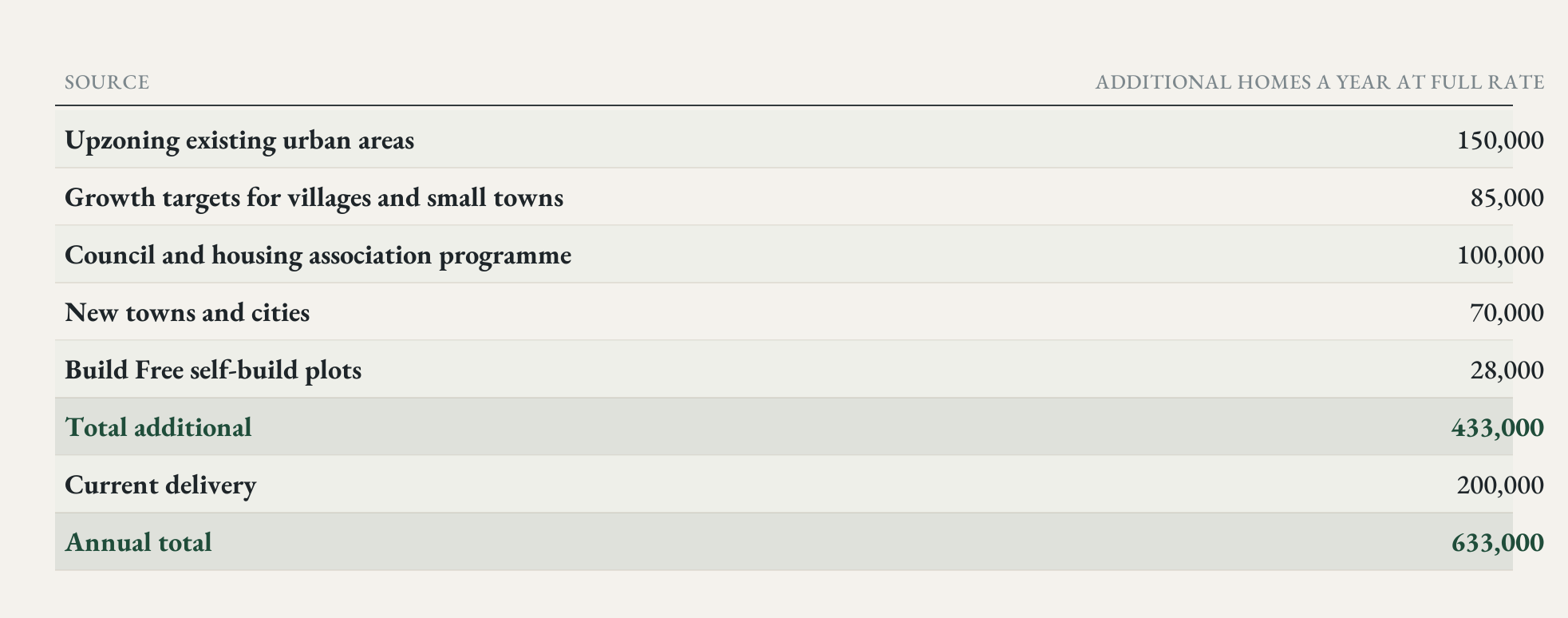
This is the answer to the Right to Buy problem, and it is the one thing no government has sincerely attempted at the right scale since the 1970s. Councils borrowing against rental income, at scale, with land assembled by development corporations and a national programme rather than a bidding round. We are selling 14,000 council homes a year. We should be building many times that, and the figure falls out of the delivery table below. At that rate the right to buy one costs nobody anything, because there are several more behind it.
How the numbers are delivered
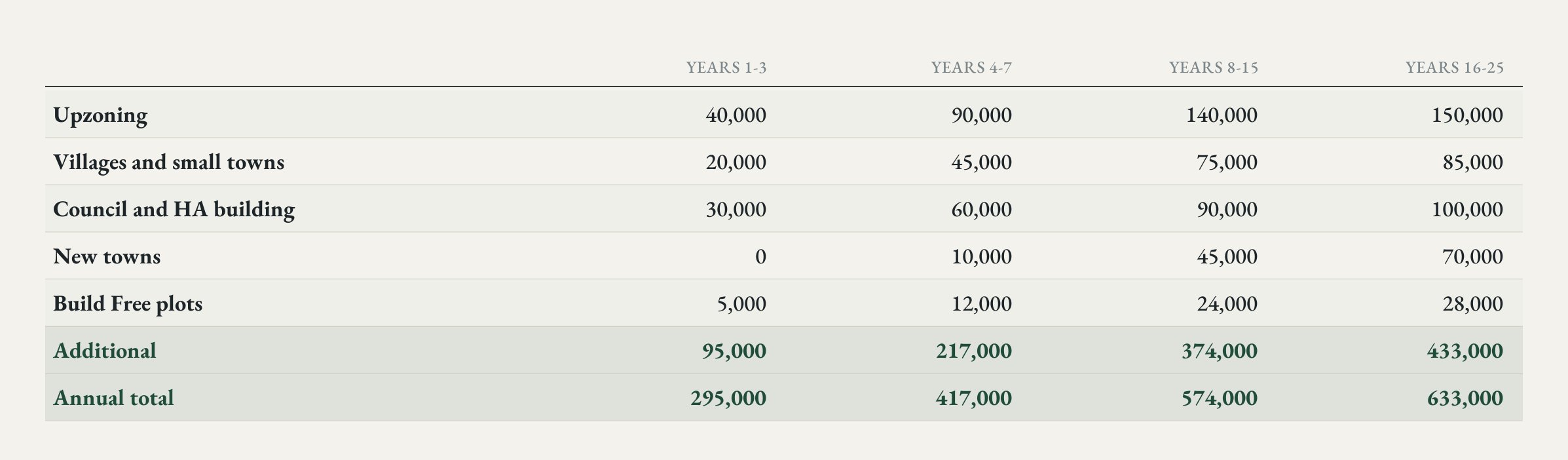
Current delivery is running at around 200,000 net additions a year in England, which is roughly what new household formation absorbs. Everything above that closes the gap. Here is where the extra 433,000 comes from.